

STULZ CabinetAir PRT Outdoor Cabinet Cooling Units Australia
STULZ CabinetAir PRT Outdoor Cabinet Cooling Units Australia
Home / Precision Cooling / STULZ / CabinetAir PRT
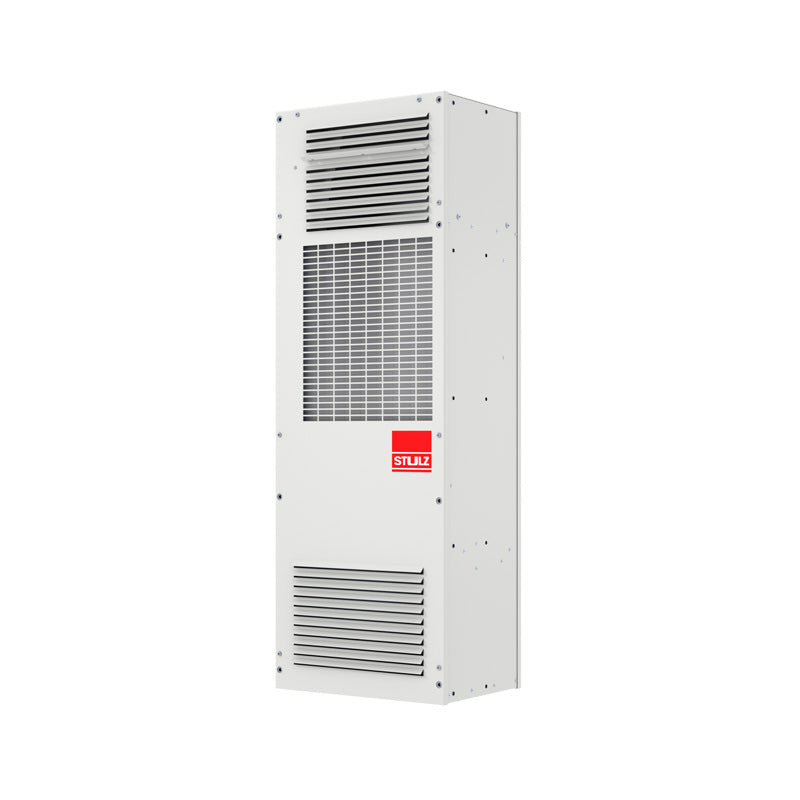
The STULZ CabinetAir PRT is a 1.0 kW to 2.0 kW Plug and Play cooling unit for a single outdoor equipment cabinet, built to hold street and roadside enclosures within their operating temperature anywhere in Australia. Three models cover the range, PRT10H at 1.0 kW, PRT14H at 1.4 kW and PRT20H at 2.0 kW, all in the same 1,200 mm high by 417 mm wide by 300 mm deep envelope, running on R134a and rated by STULZ for outside temperatures from -20 to +60 degrees Celsius. Indigi Power and Cooling supplies, installs and maintains CabinetAir PRT units nationally from hubs in Brisbane, Sydney and Melbourne.
An outdoor equipment cabinet is a small, sealed, uninsulated steel box sitting in the open. The electronics inside it dissipate perhaps a few hundred watts to a couple of kilowatts, which does not sound like much until you add the solar gain on a dark cabinet skin in full sun and remember that there is nowhere for the heat to go. The CabinetAir PRT is the STULZ answer to exactly that problem. It is by a wide margin the smallest unit in the STULZ outdoor cooling family, an order of magnitude below the shelter and container units, and it is scoped for one cabinet rather than a room, a shelter or a walk-in enclosure.
Australian conditions make the case sharper than most markets. A kerbside cabinet in Bourke, Mount Isa or the Pilbara sees ambient air that already sits close to the internal temperature limit of the equipment before the equipment has produced any heat of its own, and the cabinet skin itself can run well above ambient in direct sun. STULZ rates the CabinetAir PRT for outside temperatures up to +60 degrees Celsius, which is higher than the rest of the STULZ shelter range and is the single specification on this page that matters most to an Australian roadside deployment. At the other end of the map, a cabinet in a residential street in suburban Melbourne has a different constraint entirely, which is that whatever cools it has to be quiet enough that nobody complains about it.
Indigi Power and Cooling is an Indigenous and Veteran owned critical power and cooling specialist, registered with Supply Nation and ICN Gateway. We supply, install, commission and maintain STULZ cabinet cooling across Australia, and we work with network operators who run fleets of enclosures rather than single sites, so the conversation usually starts with how the maintenance model will scale rather than with the unit itself.
See STULZ outdoor cooling in operation
STULZ Shelter Cooling (english), 2 minutes 47 seconds. This is a range overview covering STULZ shelter and cabinet cooling generally rather than the CabinetAir PRT specifically, so treat the larger enclosures shown in it as context, not as this product.
Why the CabinetAir PRT suits street cabinets
Sized for one cabinet
1.0 kW, 1.4 kW and 2.0 kW. This is deliberately small. It is the capacity a single outdoor equipment cabinet actually needs, not a shelter unit cut down.
Quiet active cooling
STULZ describes the unit as active air conditioning that keeps the entire outdoor cabinet system running quietly. On a residential street or in a public place that is a planning consideration, not a nicety.
Direct Free Cooling
STULZ rates Direct Free Cooling as delivering huge energy savings. Whenever outside air is cool enough to do the work, the compressor stays off and the unit moves heat with fan power alone.
Plug and Play
Simple installation and simple removal. The unit is a self-contained module that mounts to the cabinet and comes off the same way, which keeps roadside working time short.
Operator serviceable
STULZ states that units can be serviced and replaced by the operator's own personnel, with no refrigeration engineers required for the swap itself. For a large, dispersed fleet this changes the cost of a site visit.
Full capacity to +60 degrees
Outside temperature range -20 to +60 degrees Celsius, with system equipment able to run at 100 per cent capacity in all operating conditions, so there are no performance fluctuations inside the cabinet.
Headline specification
| Parameter | Specification |
|---|---|
| Cooling capacity | 1.0 kW to 2.0 kW across three models |
| Models | PRT10H, PRT14H, PRT20H |
| Intended application | A single outdoor equipment cabinet. Not a shelter, container or walk-in enclosure. |
| Cooling method | Active air conditioning with Direct Free Cooling |
| Refrigerant | R134a, global warming potential 1,430 |
| Height | 1,200 mm |
| Width | 417 mm |
| Depth | 300 mm |
| Outside temperature range | -20 to +60 degrees Celsius |
| Capacity availability | System equipment can run at 100 per cent capacity in all operating conditions |
| Installation | Plug and Play, simple installation and removal |
| Serviceability | Serviced and replaced by the operator's own personnel, no refrigeration engineers required for the exchange |
| Rating conditions | Return air 35 degrees Celsius, outside air 35 degrees Celsius |
CabinetAir PRT model table
| Model | Cooling capacity kW | Height mm | Width mm | Depth mm |
|---|---|---|---|---|
| PRT10H | 1.0 | 1,200 | 417 | 300 |
| PRT14H | 1.4 | 1,200 | 417 | 300 |
| PRT20H | 2.0 | 1,200 | 417 | 300 |
The STULZ brochure prints the dimension string once for the whole CabinetAir PRT range rather than per model. Height 1,200 mm, width 417 mm and depth 300 mm therefore apply across all three models, which is consistent with the live STULZ product page. That is a useful property when you are standardising a fleet, because the cabinet cut-out and mounting arrangement do not change if you later move from a 1.0 kW to a 2.0 kW unit on the same site.
How to read a CabinetAir PRT model code
| Code element | Meaning | Example |
|---|---|---|
| PRT | The CabinetAir PRT series, outdoor cabinet cooling with Direct Free Cooling | Common to all three models |
| Capacity code | Cooling capacity in kW multiplied by ten. 10 is 1.0 kW, 14 is 1.4 kW, 20 is 2.0 kW. | 14 means 1.4 kW |
| H | Suffix carried by every model in the published CabinetAir PRT range | Present on all three |
| Worked example | PRT14H is the 1.4 kW CabinetAir PRT, the middle model in the range | PRT14H |
Direct Free Cooling on a roadside cabinet
Direct Free Cooling is the reason a 1 to 2 kW unit can have a defensible energy story at all. Whenever the outside air is cool enough to carry the cabinet's heat away on its own, the unit uses it directly and the compressor stays off. The only electrical load in that mode is fan power, which is a small fraction of what a compressor draws. When the outside air is too warm to do the job, the unit reverts to active air conditioning and holds the internal temperature regardless. STULZ positions this as huge energy savings, and on a cabinet running a constant electronics load year round the saving accrues every hour that the ambient sits below the internal setpoint.
Where that lands in Australia depends heavily on latitude. A cabinet in Hobart, Canberra, Ballarat or the New South Wales tablelands spends a large share of the year with ambient air well below the cabinet setpoint, so the compressor is idle for most of the annual hours. A cabinet in Darwin, Cairns or Karratha spends far less time in that window, and the case for the unit there rests on the active cooling capability and the +60 degrees Celsius outside rating rather than on the Free Cooling hours. Both cases are legitimate, they are just different business cases, and it is worth being honest about which one applies before the energy saving goes into a submission.
The trade-off with any direct method is that outside air is being brought to the equipment rather than kept away from it, so filtration and filter servicing become part of the operating plan. On a dusty rural highway, a road corridor under construction, or a coastal site with salt laden air, that is a real consideration and should be raised at design stage rather than discovered at the first blocked filter. Where the enclosure genuinely cannot tolerate any outside air, the unit still functions as a conventional active cooling module, you simply do not collect the Free Cooling hours.
Full capacity in all operating conditions
STULZ states that with the CabinetAir PRT the system equipment can run at 100 per cent capacity in all operating conditions, so there are no fluctuations in the performance of the IT components inside the cabinet. That claim is worth unpacking, because it is the practical difference between an active cooling unit and everything cheaper.
Passive and semi-passive cooling methods are all tied to ambient. A filtered fan set can only ever hold the cabinet above outside air temperature, so on a 42 degree afternoon the internal temperature is somewhere north of 42 degrees and the equipment inside either throttles, drops carriers, restarts, or ages faster than the asset plan assumed. A thermoelectric cooler can get below ambient, but the margin it can hold shrinks as the outside temperature climbs, which is precisely when you need it. Active refrigeration is indifferent to that. It sets the internal condition and holds it, and the +60 degrees Celsius upper limit means that limit is not going to be reached by an Australian summer, however unpleasant the day is at kerb level.
For a network operator the consequence is not really a temperature number, it is a fault statistic. Thermal derating events on radio and transmission equipment are usually invisible in the asset register and highly visible in the network performance report. Removing the temperature variable removes a category of intermittent fault that is expensive to diagnose from the network operations centre because it does not reproduce on a cool morning.
Plug and Play mounting and the swap-out maintenance model
This is the part of the CabinetAir PRT story that carries the most commercial weight in Australia, and it is also the part that gets overstated most often, so it is worth setting out precisely.
The unit is a self-contained, factory sealed and factory charged module. It mounts to the cabinet and it comes off the same way. STULZ states that units can be serviced and replaced by the operator's own personnel with no refrigeration engineers required. The mechanism behind that statement is straightforward: because the module is exchanged as a whole rather than opened, the refrigerant circuit is never broken into during a routine swap, so the person doing the exchange is not performing refrigerant handling work. An operator's own field technician can carry the replacement unit to site, disconnect and remove the failed module, mount and reconnect the replacement, and be gone, without a separate refrigeration callout being scheduled behind them.
What that does not mean is that the regulations stop applying. Any work that does involve the refrigerant circuit, including recovery, charging, leak repair, and degassing the removed module at end of life, still requires an ARCtick licensed technician under the Ozone Protection and Synthetic Greenhouse Gas Management Regulations. Electrical connection of the unit still requires a licensed electrician working to AS/NZS 3000. The saving is specific and it is real, but it is a saving on routine swap-outs, not an exemption. Written accurately in a maintenance plan it still stands up, and it is far more defensible than a claim that the unit needs no licensed trades at all.
The value of that model scales with fleet size and geography, which is exactly the shape of most Australian street cabinet estates. If you have four hundred enclosures spread across a state, the cost of every intervention is dominated by travel and by the number of separate trades that have to attend. Collapsing a cooling failure from a two visit, two trade event into a single technician visit with a replacement module in the back of the van is the whole argument. It also means a failed unit can be returned to a workshop and assessed properly instead of being diagnosed at the kerb with traffic control in place.
Monitoring, alarms and what to specify
A street cabinet is unattended by definition, so the cooling unit needs to be able to tell somebody when it is unhappy. Specify the monitoring interface at order stage rather than after the first summer. The practical questions are whether the unit can raise a volt free alarm contact into the existing site alarm loop, whether internal cabinet temperature can be reported back to the network management system alongside the equipment alarms already coming from that site, and whether the alarm thresholds can be set to something that gives useful warning rather than only reporting a failure that has already happened.
Set the high temperature warning threshold below the point at which the equipment inside starts to derate, not at its shutdown limit, so a truck roll can be planned in business hours. Indigi will walk through the available options with STULZ for the specific configuration you are ordering, because what is offered varies by model and by order code and we would rather quote what is actually available than what would be convenient.
Australian applications
- NBN and telecommunications street cabinets in residential and commercial streets, where noise and appearance both matter
- Fibre distribution and node cabinets carrying active electronics that must not thermally derate
- Kerbside and roadside equipment enclosures exposed to full sun for most of the day
- Traffic signal and intelligent transport system controller cabinets at intersections and on motorway corridors
- Rail level crossing, signalling and trackside equipment cabinets, including remote sections with long response times
- Small cell and distributed antenna system equipment enclosures on poles, rooftops and street furniture
- Utility metering, RTU and SCADA cabinets across electricity, water and gas networks
- CCTV, public safety and emergency communications enclosures in public places
- Edge compute and micro node cabinets that sit outside the scope of a conventional server room cooling design but still carry a continuous IT load
- Sites where the cabinet also houses batteries or a small inverter, which is worth reviewing alongside UPS and cooling packages because battery life is temperature driven
Two Australian conditions come up on almost every one of these. The first is solar exposure. A cabinet in an open verge with no shade collects heat through its skin all day, and the internal temperature can sit well above the shade air temperature that the weather forecast quotes. The second is vandalism and weather exposure. Roadside enclosures get hit by mowers, water, dust, wind driven rain and occasional deliberate damage, and any cooling arrangement that depends on a fragile external component will generate callouts. The swap-out model helps here too, because damage that would be a diagnostic problem at the roadside becomes a module replacement.
Three ways to cool an outdoor equipment cabinet
| Attribute | Passive ventilation with filtered fans | Thermoelectric (Peltier) cooler | STULZ CabinetAir PRT |
|---|---|---|---|
| Internal temperature versus ambient | Always above ambient. The internal temperature tracks outside air plus whatever the equipment and solar gain add. | Can go below ambient, but by a limited margin, and that margin narrows as outside temperature rises. | Holds the internal setpoint independently of ambient, with STULZ rating the unit for outside temperatures to +60 degrees Celsius. |
| Effective capacity | Entirely dependent on the temperature difference available. On a hot afternoon that difference approaches zero and so does the useful capacity. | Typically a few hundred watts per module. Reaching 1 kW means stacking modules and stacking their power draw. | 1.0 kW, 1.4 kW or 2.0 kW as a rated figure at 35 degrees Celsius return air and 35 degrees Celsius outside. |
| Energy use | Lowest of the three. Fan power only, which is why it remains attractive for very low heat loads in mild locations. | Poor coefficient of performance. A thermoelectric module commonly consumes as much electrical power as the heat it moves, or more. | Compressor load when active cooling is needed, offset by Direct Free Cooling hours whenever the outside air can do the work. |
| Dust and water ingress | Outside air passes through the cabinet by design, so filter condition is the whole defence and filter changes drive the visit schedule. | Generally separates internal and external air paths, which is its main advantage over plain ventilation. | In active cooling the internal and external air paths are separate. In Direct Free Cooling filtered outside air is used deliberately, so filtration needs to be specified for the site. |
| Noise | Can be the noisiest option in practice, because fans have to run hard and continuously to move enough air on a small temperature difference. | Fans run on both the hot and cold sides, usually continuously while the module is energised. | STULZ positions the unit as active air conditioning that keeps the whole cabinet system running quietly, which is the design intent for residential streets and public places. |
| Maintenance model | Frequent filter changes, no licensed trade needed, but a high visit count across a large fleet. | Module replacement, electrical work only, no refrigerant circuit at all. | Plug and Play swap-out by the operator's own personnel. Refrigerant circuit work and end of life degassing still go to an ARCtick licence holder. |
Installation, commissioning and maintenance in Australia
Electrical connection of a CabinetAir PRT is licensed work and must be carried out by a licensed electrician to AS/NZS 3000. Any work on the refrigerant circuit requires an ARCtick licensed refrigeration technician under the Ozone Protection and Synthetic Greenhouse Gas Management Regulations, and that includes recovering the R134a charge from a module that is being retired. AS/NZS 3666 governs the microbial control of air handling and water systems in buildings, so it will not normally be triggered by a standalone street cabinet, but it does come into scope where the same maintenance contract also covers building mounted mechanical ventilation plant, and it is worth checking which of your sites fall on which side of that line before the contract is written.
A typical scope for us covers heat load verification against the actual equipment draw in the cabinet rather than the nameplate, a review of solar exposure and orientation at the specific site, confirmation of the cabinet cut-out and mounting arrangement, electrical supply and protection, condensate management, alarm and monitoring integration, and a documented commissioning record for each enclosure so that the fleet has a baseline to measure against. Where a rollout covers many cabinets we standardise the install detail once and repeat it, which is what makes the per site cost sensible.
Pricing for cabinet cooling is quoted per site or per rollout rather than from a price band, because the cost is driven by the number of enclosures, their geographic spread, traffic management requirements and whether the electrical supply already exists at the cabinet. Send us the site list and we will price it properly. Our published design and install bands are for server room cooling projects and are not a sensible guide for a 1 to 2 kW street cabinet unit.
For ongoing support, see our CRAC unit maintenance services and DX servicing pages. For enclosure fleets we normally build a schedule around filter condition, condensate drainage, external grille and coil cleanliness, mounting and seal integrity, alarm test, and a spares holding of exchange modules sized to the fleet and the response time you are committing to.
Frequently asked questions
What is the cooling capacity of the STULZ CabinetAir PRT?
The CabinetAir PRT covers 1.0 kW to 2.0 kW across three models. PRT10H is 1.0 kW, PRT14H is 1.4 kW and PRT20H is 2.0 kW. Capacities are quoted at 35 degrees Celsius return air and 35 degrees Celsius outside temperature. This is the smallest unit in the STULZ outdoor cooling range covered here and it is scoped for a single equipment cabinet, not a shelter or container.
What are the dimensions of the CabinetAir PRT?
Height 1,200 mm, width 417 mm and depth 300 mm. The same envelope applies across all three models, so the cabinet cut-out and mounting arrangement do not change if you move between the 1.0 kW, 1.4 kW and 2.0 kW units on the same enclosure design.
Can our own technicians replace a CabinetAir PRT without a refrigeration licence?
For a routine swap, yes. STULZ states that units can be serviced and replaced by the operator's own personnel with no refrigeration engineers required, because the unit is a sealed Plug and Play module that is exchanged as a whole rather than opened, so the refrigerant circuit is never broken into. Any work that does involve the refrigerant circuit, including recovery, charging, leak repair and degassing a retired module, still requires an ARCtick licensed technician under the Ozone Protection and Synthetic Greenhouse Gas Management Regulations. Electrical connection still requires a licensed electrician to AS/NZS 3000.
What outside temperature can the CabinetAir PRT operate in?
STULZ specifies an outside temperature range of -20 to +60 degrees Celsius. The +60 degrees Celsius upper limit is higher than the rest of the STULZ shelter cooling range and is directly relevant to Australian roadside cabinets standing in full summer sun, where the air immediately around a dark cabinet skin can be considerably hotter than the shade temperature in the forecast.
How does Direct Free Cooling save energy on an outdoor cabinet?
Whenever outside air is cool enough to carry the cabinet heat load away on its own, the unit uses it directly and the compressor stays off, leaving fan power as the only significant electrical load. STULZ rates this as delivering huge energy savings. How much you actually collect depends on location. Cooler southern and tableland sites spend many more hours per year in the Free Cooling window than sites in Darwin, Cairns or the Pilbara.
Is the CabinetAir PRT quiet enough for a residential street?
STULZ describes the CabinetAir PRT as active air conditioning that keeps the entire outdoor cabinet system running quietly, and quiet running is one of the stated design intents precisely because these cabinets sit on residential streets and in public places. Where a specific noise limit applies under a local planning condition, send it to us with the site details and we will confirm the selection against it rather than assume.
Who supplies and services STULZ CabinetAir PRT units in Australia?
Indigi Power and Cooling supplies, installs, commissions and maintains STULZ cabinet cooling across Australia from hubs in Brisbane, Sydney and Melbourne. Electrical work is carried out to AS/NZS 3000 and all refrigerant circuit work by ARCtick licensed technicians. Indigi is Indigenous and Veteran owned and registered with Supply Nation and ICN Gateway, and we support fleet rollouts as well as single enclosures.
Where we supply and service
Brisbane and QLD
Brisbane CBD, Woolloongabba, Eight Mile Plains, Port of Brisbane, Gold Coast, Sunshine Coast, Ipswich, Townsville, Cairns
National HQ at Tingalpa and the base for exchange module stock. Long regional corridors north and west make the swap-out model worth the most here.
Sydney and NSW
Sydney CBD, Parramatta, North Ryde, Macquarie Park, Western Sydney, Newcastle, Wollongong, Canberra (ACT)
The densest street cabinet estate in the country. Western Sydney summer ambients and residential noise expectations both bear on the selection.
Melbourne and VIC
Melbourne CBD, Port Melbourne, Docklands, Dandenong, Tullamarine, Geelong, Ballarat, regional Victoria
The strongest Direct Free Cooling hours on the mainland, so the energy argument stands up best in Victorian street cabinet rollouts.
Perth and WA
Perth CBD, Fremantle, Kalgoorlie, Pilbara, regional WA
Extreme inland ambients and very long drive times. This is where the +60 degrees Celsius rating and an on-site spare module both earn their keep.
Adelaide and SA
Adelaide CBD, Port Adelaide, Salisbury, Mount Gambier, Whyalla, regional SA
Hot dry summers with good Free Cooling hours either side of them. Dust loading on filters is the item to plan for on rural highway sites.
Darwin and NT
Darwin CBD, Palmerston, Katherine, Alice Springs, remote NT sites
Few Free Cooling hours, so the case rests on active capacity and humidity handling. Condensate drainage detail needs specific attention here.
Western Australia, Tasmania and Pacific Islands: cabinet cooling visits are scheduled in planned blocks so that travel is shared across multiple enclosures, and we can combine street cabinet work with UPS and battery attendance in the same mobilisation. Contact us to discuss scheduling.
Related products and services
- CRAC unit maintenance services Australia
- DX CRAC servicing across Brisbane, Sydney and Melbourne
- Cooling installation and commissioning
- Server room cooling Australia
- Server room UPS and cooling packages
- Server room heat load calculator
- UPS, battery and cooling maintenance in Brisbane
|
Get a CabinetAir PRT quotation for your cabinet fleet Send us the equipment heat load per cabinet, the enclosure dimensions, the site list and whether power is already at the cabinet, and we will come back with a model selection and an installed price per site. Indigi Power and Cooling is Indigenous and Veteran owned, and registered with Supply Nation and ICN Gateway. Contact Indigi Power and Cooling |
Partner with Us
Reliable Power & Cooling Solutions from Indigi Power & Cooling Expert supply, installation, and contracting services for critical infrastructure across Australia.