Data centre liquid cooling removes heat directly at the rack or chip using a circulating fluid instead of room air, letting Australian operators cool high-density AI and GPU racks that air cooling can no longer handle.
Indigi Power and Cooling supplies, designs and installs the full Vertiv Liebert liquid cooling range -- coolant distribution units, rear door heat exchangers, direct-to-chip modules and immersion systems -- across Brisbane, Sydney, Melbourne and every state. As an Indigenous and Veteran-owned specialist, we are Supply Nation and ICN Gateway registered.
Rack power densities have climbed faster than any other number in the data centre. A cabinet that drew 5 to 8 kW a decade ago now routinely draws 30, 50 or more than 100 kW once it is filled with GPU accelerators for AI training and inference. Traditional air cooling, even with contained hot and cold aisles, runs out of headroom somewhere around 15 to 20 kW per rack. Beyond that point the only practical answer is to bring liquid to the heat.
This collection brings together the Vertiv liquid cooling platform Indigi supplies in Australia, from coolant distribution units and rear door heat exchangers through to full immersion systems. Below the product range you will find a plain-English guide to each cooling method, a side-by-side comparison table, guidance on when to move from air to liquid, and answers to the questions our engineers are asked most. Every unit here can be supplied on its own or delivered as part of a designed and commissioned installation by our team.
What is data centre liquid cooling?
Data centre liquid cooling is a family of techniques that transfer heat away from IT equipment using a liquid coolant rather than relying on room air conditioning alone. Liquid carries roughly 3,000 times more heat per unit volume than air, so a small flow of water or dielectric fluid can remove far more heat than a large volume of chilled air. That efficiency is what makes high-density computing viable.
There are three broad approaches, and most modern facilities use a blend of them alongside conventional room cooling. Rear door heat exchangers mount on the back of the rack and neutralise heat as air leaves the cabinet. Direct-to-chip cooling pipes coolant to cold plates sitting on the hottest components, the CPUs and GPUs. Immersion cooling submerges entire servers in a non-conductive dielectric fluid. All three rely on a coolant distribution unit to move fluid between the technology loop and the facility water system, keeping the two safely isolated.
Liquid cooling also improves energy efficiency. Because it captures heat at higher temperatures and reduces or removes the need for fans, well-designed liquid systems can cut cooling energy substantially and support a lower facility PUE, while keeping equipment comfortably inside the ASHRAE TC 9.9 recommended envelope of 18 to 27 degrees Celsius at the air intake where air is still used.
Liquid cooling methods compared
Choosing between rear door, direct-to-chip and immersion cooling comes down to your rack density, how far you want to retrofit, and whether your hardware is designed for liquid. The table below summarises where each method fits. Our engineers apply the same logic when scoping a project against your data centre and IT infrastructure requirements.
Table: Liquid cooling methods by typical rack density, retrofit effort and heat capture
| Method |
Typical density |
Heat to liquid |
Best for |
| Air cooling (baseline) |
Up to 15 to 20 kW/rack |
0% |
Standard IT loads, mixed workloads |
| Rear door heat exchanger (RDHx) |
Up to 40 to 60 kW/rack |
Neutralises rack exhaust |
Retrofit into existing rooms, no server change |
| Direct-to-chip (cold plate) |
50 to 130+ kW/rack |
Around 70 to 80% |
GPU and AI clusters, hybrid air plus liquid |
| Immersion cooling |
100+ kW/rack equivalent |
Up to 100% |
Highest density, edge and HPC, fan-free |
The Vertiv liquid cooling range we supply
Indigi is a Vertiv Liebert supplier, and the products in this collection cover every rung of the liquid cooling ladder. You can browse the full range in the grid on this page; the summary below explains where each one fits.
Coolant distribution units (CDU)
A coolant distribution unit is the heart of any liquid cooling deployment. It isolates the clean technology cooling loop that touches your servers from the facility water loop, controls flow and temperature, and monitors for leaks. The Vertiv CoolChip CDU and Liebert XDU coolant distribution units in this collection serve direct-to-chip and rear door systems, and the Liebert XDP and XDH pumping and cooling module pair provides refrigerant-based distribution for high-density rows.
Rear door heat exchangers
The Vertiv CoolLoop RDHx replaces the standard rear door of a rack with a passive or active heat exchanger, capturing hot exhaust air before it re-enters the room. It is the least disruptive way to lift a room from air to liquid because the servers themselves are untouched, making it ideal for retrofitting an existing server room that has run out of cooling headroom.
Direct-to-chip cooling modules
The Liebert XDC, Liebert XDH, Liebert XDO and Liebert XDV cooling modules deliver chilled coolant close to the rack for cold-plate and high-density row cooling. These modules pair with a CDU to cool the CPUs and GPUs directly while conventional room cooling handles the residual air load.
Immersion cooling
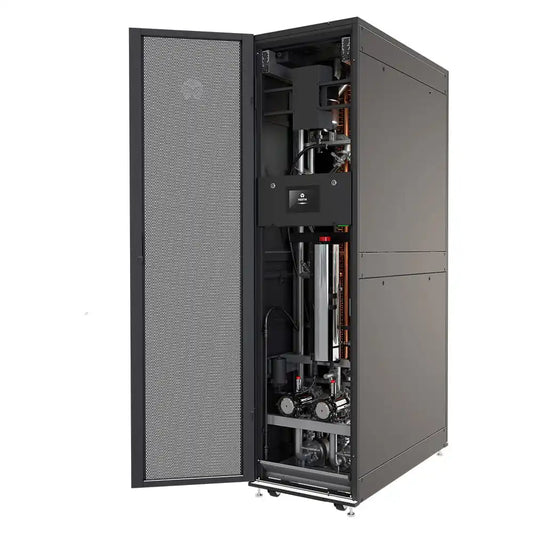
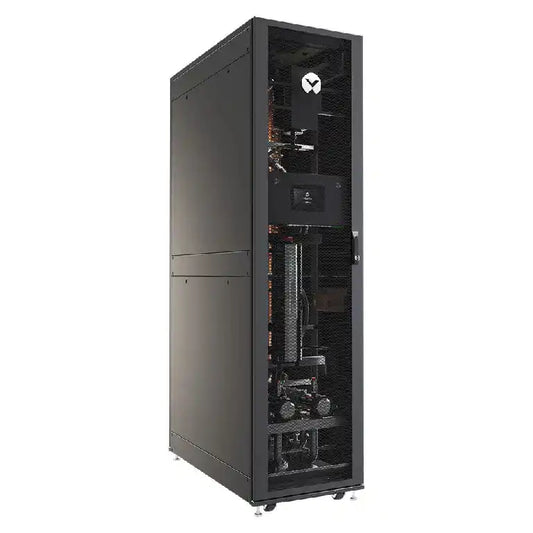
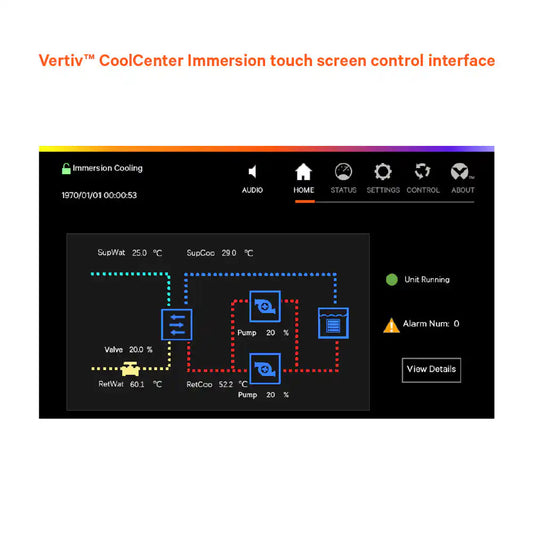
The Vertiv CoolCenter Immersion Cooling System submerges servers in a non-conductive dielectric fluid, removing nearly all heat with no server fans at all. It suits the very highest densities, edge deployments and high-performance computing where air and even cold-plate cooling reach their limits.
When to move from air to liquid cooling
The transition from air to liquid cooling is usually triggered by high-density racks rather than a whole-room refresh. If a single rack exceeds roughly 20 kW, if your CRAC or CRAH units are running flat out and hot spots keep appearing, or if you are deploying GPU servers for AI workloads, you have reached the point where liquid should be on the table. Many Australian operators start with rear door heat exchangers on the hottest cabinets, then add direct-to-chip as GPU density grows, keeping their existing room cooling as the backbone.
Getting the design right matters as much as the hardware. A liquid deployment has to account for water quality, flow rates, leak detection, redundancy and how the technology loop ties into the building chilled water system, all while meeting AS/NZS 3000 electrical and AS/NZS 3666 mechanical requirements. Our team scopes this end to end, sizing the solution against your rack heat load before recommending any hardware. Full liquid-ready cooling design and installation typically falls in the same bands as our server room cooling projects, from around $8k to $15k for small rooms up to $45k to $60k and beyond for large high-density halls.
Liquid cooling supply and installation across Australia
Brisbane CBD, Woolloongabba, Eight Mile Plains, Port of Brisbane, Gold Coast, Sunshine Coast, Ipswich, Townsville, Cairns
Our HQ hub, holding Vertiv liquid cooling stock and dispatching engineers statewide.
Sydney CBD, Parramatta, North Ryde, Macquarie Park, Western Sydney, Newcastle, Wollongong, Canberra (ACT)
High-density and AI colocation support across the Sydney data centre corridor.
Melbourne CBD, Port Melbourne, Docklands, Dandenong, Tullamarine, Geelong, Ballarat, regional Victoria
Design and commissioning for GPU and HPC deployments across Victoria.
Perth and WA
Perth CBD, Fremantle, Kalgoorlie, Pilbara, regional WA
Served from our national hubs for supply and scheduled installation.
Adelaide and SA
Adelaide CBD, Port Adelaide, Salisbury, Mount Gambier, Whyalla, regional SA
Liquid cooling supply and project delivery from our national hubs.
Darwin and NT
Darwin CBD, Palmerston, Katherine, Alice Springs, remote NT sites
Remote and edge high-density cooling supported nationwide.
Western Australia, Tasmania and Pacific Islands: we supply and coordinate liquid cooling installation for remote, island and offshore sites on a scheduled basis.
Contact us to discuss scheduling.
Data centre liquid cooling FAQs
What is a coolant distribution unit (CDU)?
A coolant distribution unit isolates the clean coolant loop that touches your servers from the facility water loop, then controls flow, regulates temperature and monitors for leaks. Every direct-to-chip and rear door liquid cooling deployment needs one. Indigi supplies Vertiv CoolChip and Liebert XDU units for this role.
When do I need to switch from air to liquid cooling?
Once a rack exceeds roughly 15 to 20 kW, air cooling struggles to keep up. GPU and AI servers routinely push past this, so most operators add rear door heat exchangers or direct-to-chip cooling to the hottest racks while keeping room cooling for the rest. Sizing your heat load first tells you exactly where you sit.
What is the difference between direct-to-chip and immersion cooling?
Direct-to-chip cooling pipes coolant to cold plates on the hottest components and captures around 70 to 80% of the heat to liquid, with room air handling the rest. Immersion cooling submerges the whole server in a dielectric fluid and can capture close to 100% of the heat with no fans, giving the highest density but requiring purpose-built tanks and hardware.
Can liquid cooling be retrofitted into an existing server room?
Yes. Rear door heat exchangers such as the Vertiv CoolLoop RDHx replace the rack's rear door and need no change to the servers, making them the least disruptive retrofit. From there you can add direct-to-chip cooling as density grows. Our engineers design the tie-in to your existing chilled water system.
Does liquid cooling require maintenance?
Yes. Coolant quality, flow rates, filters, pumps and leak-detection sensors should be checked on a scheduled basis, and the facility water side serviced like any chilled water plant. Indigi offers scheduled servicing alongside our CRAC and critical power maintenance programs so your liquid cooling is covered under one plan.
Is liquid cooling more energy efficient than air cooling?
Generally yes. Because liquid captures heat at higher temperatures and cuts or removes fan power, a well-designed liquid system uses less cooling energy and supports a lower facility PUE than air cooling at the same density, while keeping equipment within the ASHRAE 18 to 27 degrees Celsius envelope where air is still used.
Related services and resources
|
Scoping high-density or AI cooling? Let's size it together.
Tell us your rack densities and room layout and we will recommend the right liquid cooling method, supply the Vertiv hardware and install it. Indigi is an Indigenous and Veteran-owned specialist, Supply Nation and ICN Gateway registered.
Contact Indigi Power and Cooling
|