


STULZ CyberAir 3PRO DX Precision Air Conditioning Units Australia
STULZ CyberAir 3PRO DX Precision Air Conditioning Units Australia
Home / Precision Cooling / STULZ / CyberAir 3PRO DX
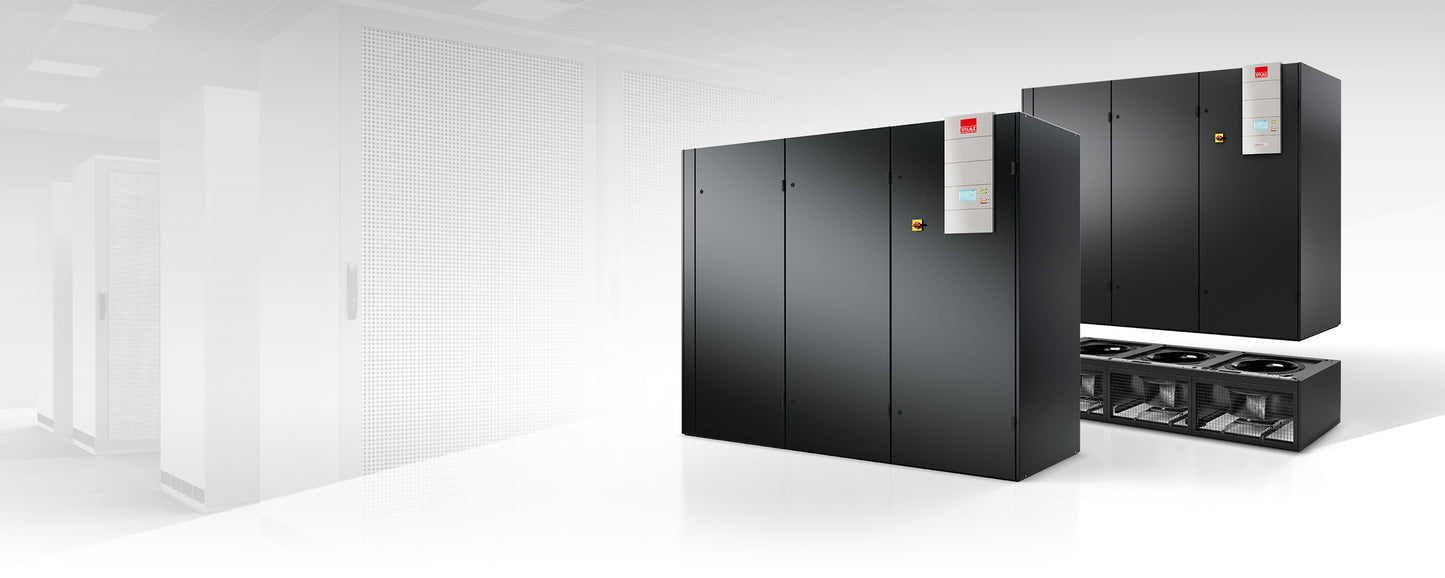
The STULZ CyberAir 3PRO DX is a direct expansion (DX) computer room air conditioning unit delivering 20 kW to 150 kW of cooling capacity in six sizes and five cooling systems, engineered for data centre and server room applications across Australia. It is available in downflow (ASD), upflow (ASU) and raised floor (ASR) air conduction, with Direct Free Cooling and Indirect Dynamic Free Cooling options that cut compressor running costs substantially. Indigi Power and Cooling supplies, installs, commissions and maintains CyberAir 3PRO DX units nationally from hubs in Brisbane, Sydney and Melbourne.
Precision cooling is not the same as comfort air conditioning. A CRAC unit runs continuously, every hour of every day, and is sized on sensible heat rather than the latent load that dominates an office system. The CyberAir 3PRO DX sits at the upper end of that category. It is the direct expansion member of the CyberAir 3PRO family, built on more than three decades of STULZ development work, and it is specified where a site needs high cooling density from a small floor plate without giving up efficiency.
For Australian operators the appeal is usually threefold. The unit fits through a standard doorway despite its capacity, which matters when retrofitting an existing comms room in a CBD tower. It holds supply air temperatures inside the ASHRAE TC 9.9 recommended envelope, which keeps the IT load reliable and the energy bill defensible. And its Free Cooling variants exploit the cooler shoulder seasons in Melbourne, Canberra, Hobart and inland New South Wales, where outside air can carry a meaningful share of the annual cooling hours.
Indigi Power and Cooling is an Indigenous and Veteran owned critical power and cooling specialist, registered with Supply Nation and ICN Gateway. We handle CyberAir 3PRO DX supply, installation, commissioning and ongoing maintenance, and we also service the installed base of STULZ equipment already running in Australian facilities.
See the CyberAir 3PRO in operation
STULZ CyberAir 3PRO product overview, 3 minutes 29 seconds. Covers both the DX and CW configurations.
Why the CyberAir 3PRO DX leads its class
Capacity per square metre
Up to 150 kW total gross cooling from a cabinet 950 mm to 3,110 mm wide and only 890 mm to 980 mm deep. Every size fits through a standard door.
EER up to 5.6
Energy Efficiency Ratio reaches 5.6 kW/kW on Free Cooling raised floor models, with Airflow Efficiency Ratio as low as 0.04 W per cubic metre per hour.
Direct Free Cooling
With the FreeCool Plenum option, filtered outside air cools the room directly. STULZ rates this at up to 90 per cent more economical than compressor only operation.
Indirect Dynamic Free Cooling
Variable speed pumps, dry coolers and EC compressors run without a fixed changeover setpoint, reducing total energy consumption by up to 60 per cent across all active components.
Five cooling systems
A/AS air cooled, G water cooled, GE/GES hybrid Free Cooling, ACW and GCW dual fluid. Dual fluid units carry a second independent circuit for redundancy.
Front access servicing
All maintainable components are reachable from the front, so units can be installed against a wall. Filters run ISO 16890 Coarse 80 per cent up to ePM10 70 per cent.
Range specification at a glance
| Parameter | Specification |
|---|---|
| Total cooling capacity | 20 kW to 150 kW |
| Airflow volume | 4,000 to 32,000 cubic metres per hour |
| Air conduction | ASD downflow, ASU upflow, ASR raised floor with front or front/back/down discharge |
| Height | 1,980 mm standard, 2,495 mm for ASR (1,980 mm above raised floor plus 515 mm in floor) |
| Width | 950 mm to 3,110 mm depending on size |
| Depth | 890 mm (up to 2,550 mm wide), 980 mm (3,110 mm wide) |
| Cooling systems | A/AS, G, GE/GES, ACW, GCW |
| Refrigerants | R407C (GWP 1,774), R410A (GWP 2,088), R134a (GWP 1,430), R513A (GWP 631), R454C (GWP 148, GE/GES only) |
| Filtration | ISO 16890, ISO Coarse 80 per cent up to ePM10 70 per cent, with filter control manager |
| Control | STULZ e2 controller, supply air, return air, room air or server inlet, Modbus preinstalled, up to 20 units in one group |
Three air conduction designs
ASD Downflow
Fans integrated in the unit, cold air discharged down into a raised floor plenum. The standard choice for a data hall with floor void distribution.
ASU Upflow
Discharge from the top of the unit, ducted or free blowing. Used where there is no floor void, which covers most Australian comms room retrofits.
ASR Raised Floor
Fan box relocated into the floor void. Frees internal space for a larger heat exchanger and cuts fan power sharply by removing turbulence and direction changes.
The ASR arrangement is worth understanding properly because it is where the efficiency numbers separate. Airflow Efficiency Ratio, the ratio of fan power consumption to airflow, drops to 0.04 W per cubic metre per hour on the smallest Free Cooling raised floor model, against 0.20 to 0.26 on the largest conventional units. Fan energy is a continuous 24/7 load, so that difference compounds across a year in a way that headline cooling capacity does not.
Model tables: air cooled downflow (ASD xxx A)
| Model | Airflow m³/h | Cooling kW | Noise dBA | EER | Width mm |
|---|---|---|---|---|---|
| ASD 171 A | 4,000 | 20.3 | 48 | 5.2 | 950 |
| ASD 211 A | 4,800 | 23.6 | 51 | 5.1 | 950 |
| ASD 231 A | 6,100 | 31.2 | 54 | 5.0 | 950 |
| ASD 341 A | 8,000 | 40.0 | 58 | 4.5 | 950 |
| ASD 361 A | 9,000 | 43.3 | 52 | 5.2 | 1,400 |
| ASD 471 A | 11,600 | 55.0 | 59 | 4.8 | 1,400 |
| ASD 531 A | 13,400 | 64.0 | 58 | 4.7 | 1,750 |
| ASD 621 A | 15,900 | 74.3 | 61 | 4.6 | 1,750 |
| ASD 701 A | 19,100 | 87.1 | 61 | 4.7 | 1,750 |
| Model | Airflow m³/h | Cooling kW | Circuits / compressors | Width mm |
|---|---|---|---|---|
| ASD 472 A | 10,500 | 54.1 | 2 / 2 | 1,750 |
| ASD 672 A | 16,100 | 82.2 | 2 / 2 | 1,750 |
| ASD 862 A | 20,800 | 104.3 | 2 / 2 | 2,200 |
| ASD 1032 A | 23,500 | 118.1 | 2 / 2 | 2,550 |
| ASD 1152 A | 26,200 | 133.2 | 2 / 4 | 2,550 |
Upflow (ASU), variable speed compressor (AS, GES), water cooled (G) and dual fluid (ACW, GCW) selections, plus R410A, R134a, R513A and R454C variants and 60 Hz supply, are quoted on application. Talk to Indigi and we will run the selection against your actual heat load and site conditions.
Free Cooling in the Australian climate
Free Cooling is the single biggest operating cost lever on this unit, and how much it is worth depends heavily on where the site is. There are two methods and they behave differently.
Direct Free Cooling with FreeCool Plenum
Filtered outside air is drawn straight into the room. The FreeCool Plenum sits on top of the unit with dampers, so it consumes no extra floor area. Operation moves through three stages automatically. In Free Cooling mode the outside air damper opens and the compressor stays off entirely, with return air mixed in if the outside air is too cold. In mixed mode the compressor runs at partial load to top up capacity. In compressor mode the outside air damper closes and the unit cools conventionally. STULZ rates the fully economised case at up to 90 per cent more economical than compressor only cooling.
The catch is that outside air enters the white space, so this suits sites with wider temperature and humidity tolerances. In coastal Australian locations, salt laden air and bushfire smoke events are real considerations that should be weighed at design stage.
Indirect Dynamic Free Cooling
No outside air enters the building. Heat is rejected through a water or glycol circuit to an external dry cooler, with an integrated Free Cooling coil in the unit. STULZ describes this as the only system with automatic efficiency optimisation, because there is no fixed changeover setpoint. Variable speed pumps, variable speed dry cooler fans and EC compressors are all regulated together against outside temperature and current heat load, which STULZ states reduces total energy consumption by up to 60 per cent across all active components.
An Extended Free Cooling mode holds cooling capacity constant by increasing airflow instead of starting the compressor, which lengthens the number of hours per year that run compressor free. For a Melbourne, Canberra or Hobart site this is usually the more defensible option, because it captures the shoulder season without exposing the room to outside air quality.
Choosing between the five cooling systems
| System | Description | Typical fit |
|---|---|---|
| A / AS | Air cooled, direct evaporator principle, external air cooled condenser. AS adds a variable speed EC compressor. | The standard fit for most Australian comms rooms and small to mid data halls with roof or ground level condenser space. |
| G | Water cooled. Heat moves to a water and glycol circuit via a brazed plate condenser, rejected through an external dry cooler. | Multi tenant buildings and long condenser runs, where minimising refrigerant charge and pipe length matters. |
| GE / GES | Hybrid Free Cooling. G system plus an integrated Free Cooling coil. GES uses an EC compressor and supports R454C. | Sites chasing the lowest running cost and the lowest GWP refrigerant, particularly in cooler southern climates. |
| ACW | Dual fluid. Chilled water primary with a fully independent air cooled DX circuit as backup in the same cabinet. | Facilities on a central chilled water plant that need cooling to survive a plant outage without a second unit. |
| GCW | Dual fluid. Chilled water primary with an independent water cooled G circuit as backup. | As above, where the backup circuit also needs to avoid an external air cooled condenser. |
Applications
- Colocation and enterprise data halls requiring 20 kW to 150 kW per unit, with sequencing across up to 20 units in a group
- Server room and comms room cooling where floor space is tight and the unit must fit through a standard door
- Hospital and pathology IT rooms with continuous uptime obligations
- Utility, rail and defence control rooms operating under APRA CPS 230 style resilience expectations
- Mining and resources site infrastructure where ambient extremes push comfort systems past their limits
- Chilled water facilities needing dual fluid redundancy without adding a second unit, via CHW CRAC arrangements
CyberAir 3PRO DX compared with Vertiv Liebert PDX
| Attribute | STULZ CyberAir 3PRO DX | Vertiv Liebert PDX |
|---|---|---|
| Capacity band | 20 kW to 150 kW | Broadly comparable mid band coverage |
| Air conduction options | Downflow, upflow, and raised floor fan box (ASR) | Downflow and upflow |
| Dual fluid redundancy | ACW and GCW, two independent circuits in one cabinet | Available on selected models |
| Lowest GWP refrigerant | R454C at GWP 148 on GE/GES | R454B and R513A on current generation |
| Australian service | Indigi Power and Cooling, national coverage | Indigi also services Liebert. See our Liebert spare parts page. |
Installation, commissioning and maintenance in Australia
A CyberAir 3PRO DX installation is a licensed job on two fronts. Electrical work must be carried out by a licensed electrician to AS/NZS 3000, and any work on the refrigerant circuit requires an ARCtick licensed refrigeration technician under the Ozone Protection and Synthetic Greenhouse Gas Management Regulations. Where the unit serves a mechanical ventilation system, AS/NZS 3666 hygiene obligations also apply. Indigi handles all of this in house rather than subcontracting the critical path.
Typical scope covers heat load verification against the actual IT draw rather than the nameplate, condenser or dry cooler siting and pipe run design, rigging and placement, refrigerant charging and leak testing, controller configuration and BMS integration over Modbus, sequencing setup where multiple units share a room, and witness commissioning with documented handover. Indicative pricing for server room cooling design and installation runs from $8,000 to $15,000 for small rooms, $25,000 to $45,000 for medium installations and $45,000 to $60,000 plus for large projects. Quoted scope always depends on the site.
Once running, the unit needs a maintenance regime that reflects continuous duty. Filters are the most common cause of a gradual capacity loss and the filter control manager will flag them, but the schedule should also cover coil condition, condensate management, refrigerant charge, compressor and fan health, humidifier service where fitted, and controller alarm history review. See our CRAC unit maintenance services and DX CRAC servicing pages for how we structure this.
Frequently asked questions
What is the cooling capacity range of the STULZ CyberAir 3PRO DX?
The CyberAir 3PRO DX covers 20 kW to 150 kW of total gross cooling capacity across six sizes, with airflow from 4,000 to 32,000 cubic metres per hour. Capacity figures are quoted at 400 V, three phase, 50 Hz with return air at 33 degrees Celsius and 30 per cent relative humidity.
What is the difference between the ASD, ASU and ASR versions?
ASD is downflow, discharging cold air into a raised floor plenum. ASU is upflow, discharging from the top of the unit for rooms without a floor void. ASR is the raised floor version, where the fan box is relocated into the floor void. ASR frees internal space for a larger heat exchanger and cuts fan power consumption significantly, with Airflow Efficiency Ratio as low as 0.04 W per cubic metre per hour on Free Cooling models.
Which refrigerants does the CyberAir 3PRO DX use?
R407C (GWP 1,774), R410A (GWP 2,088), R134a (GWP 1,430) and R513A (GWP 631) on on/off compressor models. R454C at GWP 148 is available on GE and GES hybrid Free Cooling systems, which is the lowest global warming potential option in the range.
How much can Free Cooling save on a CyberAir 3PRO DX?
STULZ rates Direct Free Cooling with the FreeCool Plenum at up to 90 per cent more economical than conventional compressor cooling, and Indirect Dynamic Free Cooling at up to 60 per cent lower total energy consumption across all active components. Actual savings depend on site location, IT load profile and how wide your temperature and humidity tolerances are.
Will a CyberAir 3PRO DX fit into an existing server room?
In most cases yes. Every size in the range is designed to pass through a standard doorway, cabinet depth is only 890 mm up to 2,550 mm wide, and all maintainable components are accessed from the front so the unit can sit against a wall. Height is 1,980 mm for standard units. The ASR version needs 2,495 mm total, being 1,980 mm above the raised floor plus 515 mm within it.
Who installs and services STULZ CRAC units in Australia?
Indigi Power and Cooling supplies, installs, commissions and maintains STULZ precision cooling equipment across Australia from hubs in Brisbane, Sydney and Melbourne. All refrigerant work is carried out by ARCtick licensed technicians and electrical work to AS/NZS 3000. We also service existing STULZ units installed by others.
What supply air temperature does the unit hold?
Supply air temperatures sit within the ASHRAE TC 9.9 recommended envelope, which is 18 to 27 degrees Celsius at the server inlet. The controller can regulate on supply air, return air, room air or server inlet temperature depending on how the room is configured.
Where we install and service
Brisbane and QLD
Brisbane CBD, Woolloongabba, Eight Mile Plains, Port of Brisbane, Gold Coast, Sunshine Coast, Ipswich, Townsville, Cairns
National HQ at Tingalpa. Stocked spares and fastest response for CyberAir units in South East Queensland.
Sydney and NSW
Sydney CBD, Parramatta, North Ryde, Macquarie Park, Western Sydney, Newcastle, Wollongong, Canberra (ACT)
Heaviest concentration of colocation floor space in the country, and where dual fluid ACW and GCW selections come up most.
Melbourne and VIC
Melbourne CBD, Port Melbourne, Docklands, Dandenong, Tullamarine, Geelong, Ballarat, regional Victoria
The strongest Free Cooling business case in mainland Australia. GE and GES selections repay their premium fastest here.
Perth and WA
Perth CBD, Fremantle, Kalgoorlie, Pilbara, regional WA
Resources sector installations with high ambient design conditions. Condenser sizing is the critical variable.
Adelaide and SA
Adelaide CBD, Port Adelaide, Salisbury, Mount Gambier, Whyalla, regional SA
Good Free Cooling hours through the cooler months, served from the Melbourne hub.
Darwin and NT
Darwin CBD, Palmerston, Katherine, Alice Springs, remote NT sites
High humidity design conditions. Latent load and condensate handling need specific attention at selection stage.
Western Australia, Tasmania and Pacific Islands: we schedule CyberAir installation and service visits in planned blocks to keep travel costs down, and we can combine cooling and UPS work into a single mobilisation. Contact us to discuss scheduling.
Related products and services
- CRAC unit maintenance services Australia
- DX CRAC servicing across Brisbane, Sydney and Melbourne
- CRAC installation and commissioning
- Server room cooling Australia
- Server room heat load calculator
- CRAC topology selector: DX, CHW or CDW
- Server room UPS and cooling packages
|
Get a CyberAir 3PRO DX selection for your site Send us your IT load, room dimensions, floor void arrangement and location and we will come back with a sized selection, a condenser or dry cooler plan and an installed price. Indigi Power and Cooling is Indigenous and Veteran owned, and registered with Supply Nation and ICN Gateway. Contact Indigi Power and Cooling |

Partner with Us
Reliable Power & Cooling Solutions from Indigi Power & Cooling Expert supply, installation, and contracting services for critical infrastructure across Australia.