


STULZ CyberAir Mini Server Room Air Conditioning Units Australia
STULZ CyberAir Mini Server Room Air Conditioning Units Australia
Home / Precision Cooling / STULZ / CyberAir Mini
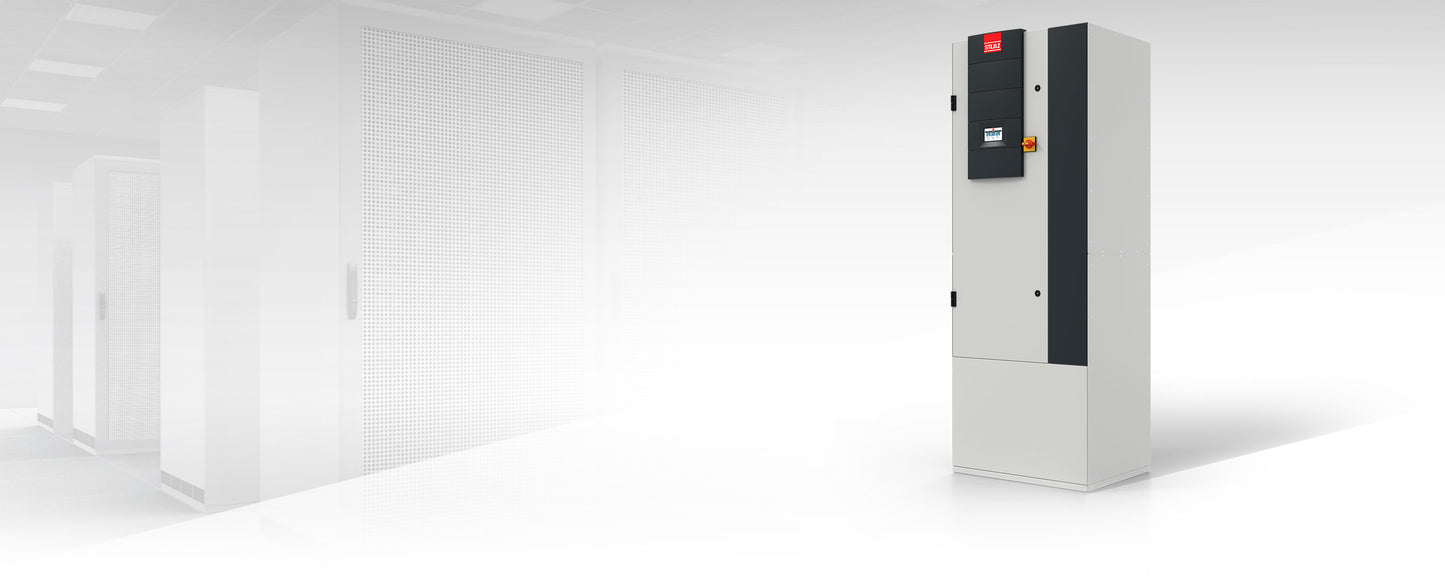
The STULZ CyberAir Mini is a precision server room air conditioning unit delivering 5.9 kW to 34.7 kW of cooling in four sizes, designed for small server rooms, comms rooms, UPS rooms and battery rooms across Australia. It is the direct successor to the STULZ MiniSpace range, and it is built to put the maximum cooling capacity into the smallest possible footprint, with cabinets from 540 mm to 1,140 mm wide that fit through a standard doorway. Indigi Power and Cooling supplies, installs, commissions and maintains CyberAir Mini units nationally from hubs in Brisbane, Sydney and Melbourne.
Most Australian IT rooms are not data halls. They are a 10 to 40 square metre room in an office floor, a hospital wing, a council depot or a school, carrying anywhere from four to twenty racks plus a UPS and its batteries. That room still needs the same things a data hall needs: stable supply air temperature, tight humidity control, continuous 24/7 duty and filtration that keeps dust off the electronics. What it does not have is floor space, a plant room, or a budget that stretches to a 100 kW machine.
The CyberAir Mini exists for exactly that gap. It covers 5.9 kW to 34.7 kW across four cabinet sizes and six cooling systems, with airflow from 1,800 to 9,200 cubic metres per hour. STULZ builds it to deliver the maximum cooling capacity from a minimal footprint, using the largest heat exchanger and filter surface areas that will fit inside the cabinet, EC fan technology and intelligent control to hold running costs down. It is a computer room air conditioning unit in the proper sense, sized on sensible heat and running every hour of the year, not a comfort split system asked to do a job it was never designed for.
Indigi Power and Cooling is an Indigenous and Veteran owned critical power and cooling specialist, registered with Supply Nation and ICN Gateway. We supply, install, commission and maintain CyberAir Mini units across Australia, and we also service the large installed base of older STULZ MiniSpace equipment already running in Australian comms rooms.
MiniSpace becomes CyberAir Mini
If you have a STULZ unit in your comms room that was specified any time from the late 1990s through to the early 2020s, there is a good chance it is a MiniSpace. STULZ has renamed and re-engineered that range as the CyberAir Mini, bringing it into line with the CyberAir naming used across the rest of the precision cooling portfolio. The product does the same job in the same part of the market. It is the small-capacity, floor-standing, front-access precision unit for rooms that are too small for a data hall CRAC and too critical for a comfort system.
The commercial point matters more than the naming. Australian sites searching for STULZ MiniSpace parts, service or a like-for-like replacement are now looking at a product with a different name, and that creates a genuine risk of a facilities manager concluding the range has been discontinued and defaulting to a comfort split. It has not been discontinued. It has been superseded, and the successor is a better unit.
The upgrade path from an existing MiniSpace
A MiniSpace to CyberAir Mini replacement is usually one of the simpler precision cooling projects on a site, because the fundamentals carry across. Cabinet height remains 1,980 mm, which is the dimension that most often governs whether a unit will physically go into an existing room with a suspended ceiling. Widths of 540 mm, 740 mm, 940 mm and 1,140 mm sit in the same family of footprints. Front access servicing means the replacement can go back against the same wall in the same position. Where the existing unit is chilled water fed, the pipework route, the condensate drain and the electrical supply are frequently reusable with minor modification.
What changes is the efficiency and the control. Current EC fan technology, larger heat exchanger surface area and the modern STULZ controller with its optional touchscreen typically produce a material reduction in fan energy and a much better part-load response than a unit designed two decades ago. Refrigerant is the other driver. Older units commonly ran R407C or R22 in the oldest cases, whereas current DX CyberAir Mini units use R513A at GWP 631 and the hybrid Free Cooling variants use R454C at GWP 148.
The practical sequence we run is a site survey and heat load verification, a selection against the actual measured IT load rather than the nameplate of the outgoing unit, a staged changeover plan that keeps the room cooled while the swap happens, and full commissioning with documented handover. On a single-unit room that usually means temporary cooling for the changeover window. On a room with N+1 already in place it can often be done one unit at a time with no temporary hire at all.
Why the CyberAir Mini suits small rooms
Capacity from a tiny footprint
The smallest cabinet is 540 mm wide and 540 mm deep and still delivers 5.9 kW. The largest is 1,140 mm wide and delivers 34.7 kW. Every size is 1,980 mm high and passes through a standard door.
EER up to 22.25
On chilled water the CCD 90 CW reaches an Energy Efficiency Ratio of 22.25 at 10/15 degrees Celsius water. Even the least efficient CW model in the range sits at 17.78.
Six cooling systems
A air cooled, AS air cooled with EC compressor, G water cooled, GE hybrid Free Cooling, CW chilled water and ACW chilled water with a redundant air cooled circuit in the same cabinet.
Quiet enough for an office floor
Chilled water models run from 46 dB(A) on the CCD 90 CW. That matters when the comms room shares a wall with occupied space, which is the normal case in Australian tenancies.
Low GWP refrigerants
R513A at GWP 631 on the air cooled A systems and R454C at GWP 148 on the GE hybrid Free Cooling systems, which keeps the site ahead of the HFC phase-down schedule.
Front access, wall mountable position
All maintainable components are reached from the front, so the unit sits flat against a wall and does not consume the clearance a rear-access machine would need.
Range specification at a glance
| Parameter | Specification |
|---|---|
| Cooling capacity | 5.9 kW to 34.7 kW |
| Airflow volume | 1,800 to 9,200 cubic metres per hour |
| Number of sizes | Four cabinet sizes |
| Air conduction | Upflow (CCU) and downflow (CCD), with intake and exhaust front and left, left only, or all directions |
| Cooling systems | A, AS, G, GE, CW, ACW |
| Height | 1,980 mm on every size in the range |
| Width and depth | 540 x 540 mm, 740 x 540 mm, 940 x 640 mm, 1,140 x 640 mm |
| Refrigerants | R513A (GWP 631) on A systems, R454C (GWP 148) on GE hybrid Free Cooling systems |
| Sound pressure | 46 to 59 dB(A) on chilled water models, 59 to 72 dB(A) on DX and hybrid models |
| Options | Direct and Indirect Free Cooling, pressure independent control valve for CW, filter classes, heating, humidification |
| Control | STULZ controller, optional touchscreen, intelligent capacity control across the unit group |
Model tables: chilled water (CW)
| Model | Air conduction | Cooling kW | Airflow m³/h | EER | Sound dB(A) | H x W x D mm |
|---|---|---|---|---|---|---|
| CCD 90 CW | Downflow | 8.9 | 2,800 | 22.25 | 46 | 1,980 x 540 x 540 |
| CCU 90 CW | Upflow | 8.9 | 2,800 | 17.80 | 50 | 1,980 x 540 x 540 |
| CCD 180 CW | Downflow | 16.0 | 4,500 | 20.00 | 53 | 1,980 x 740 x 540 |
| CCU 180 CW | Upflow | 16.0 | 4,500 | 17.78 | 54 | 1,980 x 740 x 540 |
| CCD 260 CW | Downflow | 24.5 | 6,600 | 20.42 | 55 | 1,980 x 940 x 640 |
| CCU 260 CW | Upflow | 24.5 | 6,600 | 18.85 | 56 | 1,980 x 940 x 640 |
| CCD 350 CW | Downflow | 34.7 | 9,200 | 20.41 | 58 | 1,980 x 1,140 x 640 |
| CCU 350 CW | Upflow | 34.7 | 9,200 | 19.28 | 59 | 1,980 x 1,140 x 640 |
The chilled water models are the efficiency story in this range. An EER of 22.25 on the CCD 90 CW means the unit is moving roughly 22 kW of heat for every kilowatt of electrical input at the stated conditions, because there is no compressor in the unit. That only applies where the building already has a chilled water plant with capacity to spare and a service agreement that guarantees it runs outside business hours, which is the usual catch in a commercial tenancy. Where the plant shuts down at night or on weekends, chilled water alone is not a safe basis for a critical room, and the ACW dual-fluid option or a DX selection is the better answer.
Model tables: air cooled (A) and hybrid Free Cooling (GE)
| Model | Cooling kW | Airflow m³/h | EER | Sound dB(A) | H x W x D mm |
|---|---|---|---|---|---|
| CCD 41 A | 5.9 | 1,800 | 4.92 | 60 | 1,980 x 540 x 540 |
| CCD 61 A | 8.2 | 2,100 | 4.82 | 63 | 1,980 x 540 x 540 |
| CCD 81 A | 10.3 | 2,700 | 4.90 | 67 | 1,980 x 740 x 540 |
| CCD 111 A | 11.3 | 3,100 | 4.52 | 70 | 1,980 x 740 x 540 |
| CCD 141 A | 14.1 | 4,800 | 4.70 | 67 | 1,980 x 940 x 640 |
| CCD 171 A | 16.8 | 5,200 | 4.80 | 68 | 1,980 x 940 x 640 |
| Model | Cooling kW | Airflow m³/h | EER | Sound dB(A) | H x W x D mm |
|---|---|---|---|---|---|
| CCD 41 GE | 8.1 | 1,700 | 4.50 | 59 | 1,980 x 540 x 540 |
| CCD 61 GE | 10.3 | 1,900 | 3.96 | 62 | 1,980 x 540 x 540 |
| CCD 81 GE | 12.2 | 2,700 | 3.81 | 69 | 1,980 x 740 x 540 |
| CCD 111 GE | 13.6 | 3,100 | 3.68 | 72 | 1,980 x 740 x 540 |
| CCD 141 GE | 20.5 | 4,800 | 4.36 | 70 | 1,980 x 940 x 640 |
| CCD 171 GE | 22.7 | 5,100 | 4.05 | 71 | 1,980 x 940 x 640 |
Upflow (CCU) variants of the DX and GE models, AS units with a variable speed EC compressor, water cooled G units and ACW dual-fluid selections are quoted on application. Send us your heat load and site conditions and we will run the selection properly rather than picking off a table.
Reading a CyberAir Mini model number
| Element | Meaning | Example |
|---|---|---|
| CC | CyberAir Mini family identifier | Common to every model in the range |
| D or U | Air conduction direction. D is downflow, U is upflow. | CCD 350 CW is downflow, CCU 350 CW is the upflow equivalent |
| Leading digits | Nominal cooling capacity in kW. Rated output varies with the conditions quoted in each table. | 35 in CCD 350 CW, rated at 34.7 kW |
| Final digit | Number of refrigerant circuits. Zero where there is no refrigerant circuit at all. | 0 in CCD 350 CW because chilled water units have none, 1 in CCD 141 A |
| Suffix | Cooling system: A, AS, G, GE, CW or ACW | CW in CCD 350 CW is chilled water, A in CCD 141 A is air cooled |
Choosing between the six cooling systems
| System | Description | Typical fit |
|---|---|---|
| A | Air cooled direct expansion with an external air cooled condenser, running R513A at GWP 631. | The default for a standalone comms room with roof or courtyard space for a condenser. Fully independent of the base building. |
| AS | As A, with a variable speed EC compressor instead of an on/off compressor. | Rooms where the IT load varies through the day or grows over time. Part-load efficiency and temperature stability are both better. |
| G | Water cooled with a direct evaporator. Heat goes to a water or glycol loop and out through an external dry cooler. | Multi-tenant towers and heritage buildings where a long refrigerant run to a condenser is not practical or not permitted. |
| GE | Hybrid Free Cooling. G system plus an integrated Free Cooling coil, running R454C at GWP 148. | Melbourne, Canberra, Hobart, Adelaide and inland NSW, where cool shoulder-season hours pay back the premium. |
| CW | Chilled water. No compressor in the unit, so EER reaches 22.25 on the smallest downflow model. | Buildings with a 24/7 chilled water plant and a written commitment that it stays available outside business hours. |
| ACW | Dual fluid. Chilled water primary with a fully independent air cooled DX circuit inside the same cabinet. | The answer where chilled water is cheap but not guaranteed. The room survives a plant outage without a second unit or a second footprint. |
Upflow, downflow and air conduction in a small room
CCD Downflow
Warm return air enters at the top, passes the heat exchanger and is discharged down into a raised floor void. The right choice where the room already has a floor plenum feeding perforated tiles at the rack fronts.
CCU Upflow
Discharge from the top of the unit, free blowing or ducted. This is the common Australian retrofit case, because most comms rooms in existing buildings have a slab floor and no void to work with.
Intake and exhaust options
Air conduction can be configured front and left, left only, or in all directions. In a narrow room that flexibility is often what decides whether the unit can be placed at all.
Air conduction deserves more attention on a small room than it usually gets. In a 30 square metre comms room the unit is only a few metres from the racks, so a poorly chosen discharge direction produces short cycling, where cold supply air finds its way straight back to the return without passing through a single server. The symptom is a room that reads cold at the CRAC and hot at the top of the third rack. Getting the intake and exhaust configuration right at selection stage costs nothing. Fixing it afterwards means ductwork, blanking panels and often a return visit.
Sizing a CyberAir Mini for a UPS room or battery room
UPS rooms and battery rooms are the applications where a small precision unit earns its cost most clearly, and they are also the ones most often sized wrongly. Three things separate them from a normal server room.
First, the heat load is not the UPS rating. A 40 kVA three-phase UPS running at 60 per cent load at 95 per cent efficiency rejects only a couple of kilowatts of heat, not 40. Sizing on the nameplate is the single most common error we see, and it produces an oversized unit that short cycles, controls poorly and wears its compressor out early. Our server room heat load calculator works this through properly, and we verify it against measured draw during a site visit.
Second, battery rooms are temperature-critical in a way server rooms are not. VRLA battery life halves for roughly every 8 to 10 degrees Celsius above 20 to 25 degrees Celsius. A battery string sitting at 35 degrees in an unconditioned room will not deliver its rated runtime and will need replacing in a fraction of its design life, which is a far larger cost than the cooling that would have prevented it. Holding the room at 20 to 25 degrees Celsius is the whole reason a battery room gets a precision unit rather than a wall split.
Third, ventilation obligations apply. Vented lead-acid and some VRLA installations require mechanical ventilation to control hydrogen concentration, and where a mechanical ventilation system serves the space, AS/NZS 3666 hygiene obligations for air handling apply alongside it. Cooling and ventilation need to be designed together, not bolted on in sequence. See our server room UPS and cooling packages for how we scope the two as one job.
A practical rule for the small end: a 10 to 15 rack room with a UPS typically lands somewhere between 8 kW and 25 kW of sensible load once you account for lighting, envelope gain and people, which puts it squarely across the CCD 61 A to CCD 350 CW span. Two smaller units in N+1 are almost always a better answer than one larger unit, because a single unit means a single point of failure and no capacity to service the machine without shutting the room's cooling down entirely.
Free Cooling and control options
Both Direct and Indirect Free Cooling are available as options across the range. Direct Free Cooling draws filtered outside air into the room when conditions allow, which is the cheapest possible cooling but exposes the space to outside air quality. In coastal Australian locations, salt-laden air, and in summer, bushfire smoke, are real considerations that belong in the design conversation rather than being discovered later. Indirect Free Cooling keeps outside air out of the room entirely and rejects heat through a water or glycol circuit to an external dry cooler, with the integrated Free Cooling coil in the GE units doing the work whenever ambient conditions permit.
On chilled water selections, the pressure independent control valve option is worth specifying. It holds the design flow rate through the coil regardless of pressure fluctuations elsewhere in the building loop, which matters in a shared plant where other tenants' valves are constantly modulating. Paired with energy-efficient pumps it removes a class of control instability that is otherwise very hard to diagnose from inside the comms room.
Beyond that, the option list covers different filter classes, various heating options and humidification. Filtration is specified to ISO 16890, and on a small room the filter is the component that most often causes a slow, unexplained loss of capacity. The STULZ controller flags filter condition, but it needs someone to be reading the alarms. The controller itself is available with an optional touchscreen and supports intelligent capacity control across a group of units, so an N+1 pair sequences rather than fighting each other.
Applications
- Small server rooms and comms rooms from roughly four racks up to twenty, where a full data hall CRAC is oversized and a comfort split is unsuitable
- UPS rooms and battery rooms needing a stable 20 to 25 degrees Celsius to protect battery design life, covered in our server room UPS and cooling packages
- Equipment rooms, MDF and IDF rooms, and network riser rooms in commercial towers
- Retrofits into existing buildings where the doorway, the ceiling height and the absence of a raised floor all constrain what can physically be installed
- Hospital, pathology and diagnostic imaging IT rooms with continuous uptime obligations
- Council, utility, rail and defence control rooms operating under APRA CPS 230 style operational resilience expectations
- Buildings on a central chilled water plant, where CHW CRAC arrangements or an ACW dual-fluid unit make the most sense
CyberAir Mini compared with Vertiv Liebert Mini-Mate
| Attribute | STULZ CyberAir Mini | Vertiv Liebert Mini-Mate |
|---|---|---|
| Capacity band | 5.9 kW to 34.7 kW across four sizes | Small-capacity band, broadly overlapping at the lower end and typically not reaching the top of the CyberAir Mini range |
| Installation form | Floor standing, 1,980 mm high, 540 mm to 1,140 mm wide, front access | Commonly specified as a ceiling-mounted or above-ceiling unit, which frees floor area but complicates service access |
| Cooling system choice | Six systems: A, AS, G, GE, CW and ACW dual fluid | DX and chilled water variants offered, with a narrower set of hybrid and dual-fluid options |
| Lowest GWP refrigerant | R454C at GWP 148 on GE hybrid Free Cooling | Current-generation Vertiv small units are moving to lower GWP blends, so check the specific model offered |
| Predecessor range | Direct successor to STULZ MiniSpace, with a straightforward upgrade path | Long-running Liebert small-room line with its own installed base in Australia |
| Australian service | Indigi Power and Cooling, national coverage from Brisbane, Sydney and Melbourne | Indigi services Liebert equipment too. See our Liebert spare parts page. |
Installation, commissioning and maintenance in Australia
A CyberAir Mini installation is a licensed job on two fronts. All electrical work must be carried out by a licensed electrician to AS/NZS 3000, and any work on the refrigerant circuit requires an ARCtick licensed refrigeration technician under the Ozone Protection and Synthetic Greenhouse Gas Management Regulations. Where the unit forms part of a mechanical ventilation system, which is common in UPS and battery rooms, AS/NZS 3666 hygiene obligations for air handling systems apply as well. Indigi carries out all three in house rather than subcontracting the critical path.
A typical scope covers heat load verification against measured IT draw rather than nameplate ratings, condenser or dry cooler siting and pipe run design, rigging and placement into what is often a tight room with a single narrow door, refrigerant charging and leak testing, condensate drainage and pump-up where there is no gravity fall available, controller configuration and BMS integration, sequencing setup where two units run in N+1, and witness commissioning with a documented handover pack. Indicative pricing for server room cooling design and installation in the small band, which is where most CyberAir Mini projects sit, runs from $8,000 to $15,000. Medium installations run $25,000 to $45,000. Final scope always depends on the site, and condenser access is usually the variable that moves the number most.
Once running, a small room actually needs more maintenance discipline than a large one, not less, because there is rarely any redundancy to hide behind. The schedule should cover filter condition and replacement, coil cleanliness, condensate management, refrigerant charge and leak checks, compressor and EC fan health, humidifier service where fitted, and a review of the controller alarm history rather than just a glance at the current state. See our CRAC unit maintenance services, DX CRAC servicing and CRAC installation and commissioning pages for how we structure the work. Where the same room holds a UPS, we combine cooling and UPS attendance into one visit. UPS one-off maintenance is $720 ex GST and the standard annual plan is $1,940 per year ex GST.
Frequently asked questions
What size room does the STULZ CyberAir Mini suit?
The CyberAir Mini covers 5.9 kW to 34.7 kW of cooling across four cabinet sizes, with airflow from 1,800 to 9,200 cubic metres per hour. In practice that suits small server rooms, comms rooms, equipment rooms, UPS rooms and battery rooms from roughly four racks up to about twenty, depending on rack density. Above that band the STULZ CyberAir 3PRO range is the better selection.
Is the CyberAir Mini the replacement for the STULZ MiniSpace?
Yes. MiniSpace becomes CyberAir Mini. STULZ has renamed and re-engineered the MiniSpace range as the CyberAir Mini to align it with the wider CyberAir portfolio. It occupies the same position in the market, keeps the 1,980 mm cabinet height that usually governs whether a unit fits an existing room, and offers a straightforward upgrade path for the installed base of MiniSpace units in Australian comms rooms. Indigi services existing MiniSpace units and quotes like-for-like CyberAir Mini replacements.
What is the difference between the CCD downflow and CCU upflow models?
CCD is downflow, discharging cold air down into a raised floor void for distribution through perforated tiles. CCU is upflow, discharging from the top of the unit either free blowing or ducted, which suits rooms with a slab floor and no void. Most Australian retrofits into existing buildings end up as upflow. Downflow models also post better EER figures, for example 22.25 on the CCD 90 CW against 17.80 on the CCU 90 CW.
Can a CyberAir Mini cool a UPS room or battery room?
Yes, and it is one of the primary applications for the range. Battery rooms need to be held at roughly 20 to 25 degrees Celsius, because VRLA battery life halves for approximately every 8 to 10 degrees Celsius above that band. Size on the actual heat rejected by the UPS, which is the loss rather than the kVA rating, not on the nameplate. Where mechanical ventilation is required for hydrogen control, AS/NZS 3666 hygiene obligations apply alongside the cooling design.
Which cooling system should I choose for a small server room?
For a standalone room with roof or courtyard space for a condenser, the air cooled A or AS system is the default because it is independent of the base building. Where the building has a 24/7 chilled water plant, CW gives the best efficiency, with EER up to 22.25. Where chilled water exists but is not guaranteed outside business hours, ACW dual fluid adds an independent air cooled circuit inside the same cabinet. In cooler southern climates, GE hybrid Free Cooling with R454C usually returns the lowest running cost.
How much does server room air conditioning cost to install in Australia?
Indigi's indicative pricing for server room cooling design and installation is $8,000 to $15,000 for a small room, $25,000 to $45,000 for a medium installation and $45,000 to $60,000 plus for a large project. Most CyberAir Mini projects sit in the small band. The variables that move the figure most are condenser or dry cooler siting, pipe run length, electrical supply upgrades and whether the room needs temporary cooling during a changeover.
Who installs and services STULZ CyberAir Mini units in Australia?
Indigi Power and Cooling supplies, installs, commissions and maintains STULZ precision cooling equipment across Australia from hubs in Brisbane, Sydney and Melbourne. Electrical work is carried out to AS/NZS 3000 and all refrigerant work by ARCtick licensed technicians. We also service existing STULZ MiniSpace and CyberAir units installed by others, and can combine cooling and UPS maintenance into a single site attendance.
Where we install and service
Brisbane and QLD
Brisbane CBD, Woolloongabba, Eight Mile Plains, Port of Brisbane, Gold Coast, Sunshine Coast, Ipswich, Townsville, Cairns
National HQ at Tingalpa. Fastest response and stocked spares for small server room units across South East Queensland.
Sydney and NSW
Sydney CBD, Parramatta, North Ryde, Macquarie Park, Western Sydney, Newcastle, Wollongong, Canberra (ACT)
Heavy demand for CBD tower comms room retrofits, where doorway width and no raised floor drive the selection.
Melbourne and VIC
Melbourne CBD, Port Melbourne, Docklands, Dandenong, Tullamarine, Geelong, Ballarat, regional Victoria
Best Free Cooling hours on the mainland. GE hybrid selections repay their premium fastest in Victorian comms rooms.
Perth and WA
Perth CBD, Fremantle, Kalgoorlie, Pilbara, regional WA
Resources sector equipment rooms with high ambient design conditions. Condenser sizing is the critical variable.
Adelaide and SA
Adelaide CBD, Port Adelaide, Salisbury, Mount Gambier, Whyalla, regional SA
Good shoulder-season Free Cooling hours. Served from the Melbourne hub on planned schedules.
Darwin and NT
Darwin CBD, Palmerston, Katherine, Alice Springs, remote NT sites
High humidity design conditions. Latent load and condensate handling need specific attention on small rooms.
Western Australia, Tasmania and Pacific Islands: we schedule CyberAir Mini installation and service visits in planned blocks to keep travel costs down, and we can combine comms room cooling work with UPS and battery attendance in a single mobilisation. Contact us to discuss scheduling.
Related products and services
- Server room cooling Australia
- Server room UPS and cooling packages
- Server room heat load calculator
- CRAC topology selector: DX, CHW or CDW
- CRAC unit maintenance services Australia
- DX CRAC servicing across Brisbane, Sydney and Melbourne
- CHW CRAC maintenance for chilled water units
- CDW CRAC servicing
- CRAC installation and commissioning
|
Get a CyberAir Mini selection for your server room Send us your rack count, UPS rating, room dimensions, doorway width and location, and tell us whether you have a raised floor and access to chilled water. We will come back with a sized selection, a condenser or dry cooler plan and an installed price. If you are replacing a STULZ MiniSpace, send the model plate photo as well. Indigi Power and Cooling is Indigenous and Veteran owned, and registered with Supply Nation and ICN Gateway. Contact Indigi Power and Cooling |

Partner with Us
Reliable Power & Cooling Solutions from Indigi Power & Cooling Expert supply, installation, and contracting services for critical infrastructure across Australia.