


STULZ CyberLab Laboratory and Archive Climate Control Units Australia
STULZ CyberLab Laboratory and Archive Climate Control Units Australia
Home / Precision Cooling / STULZ / CyberLab
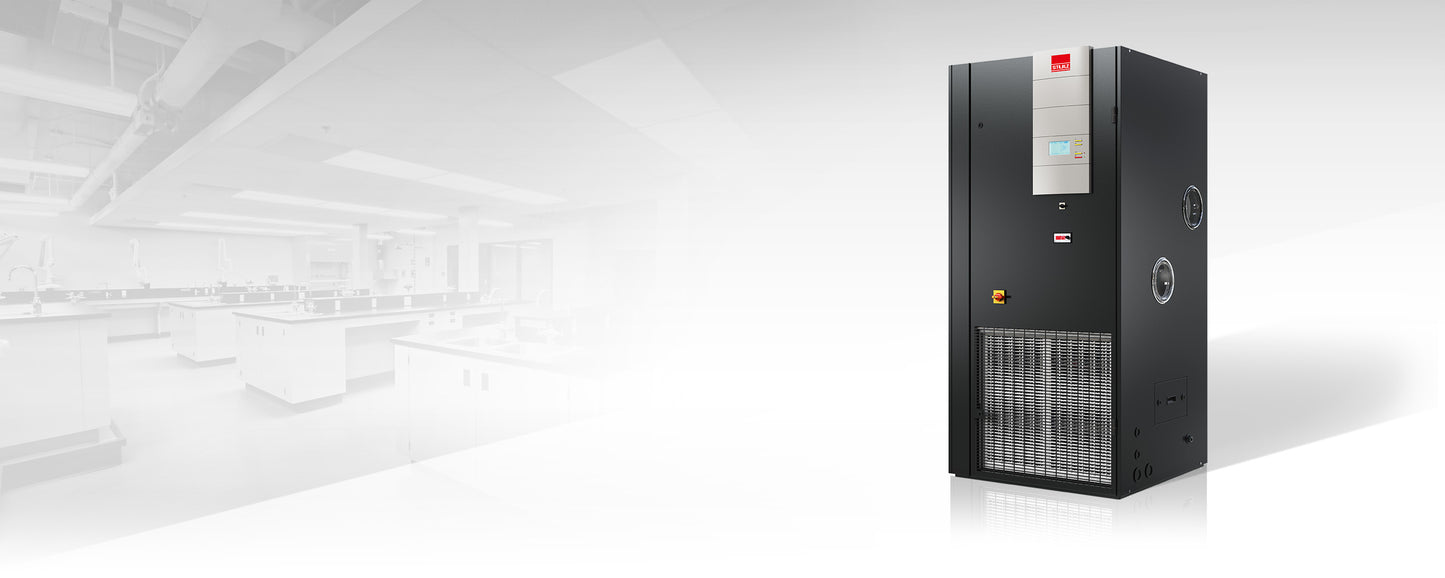
The STULZ CyberLab is a close control air conditioning unit that holds temperature to within plus or minus 0.5 K and relative humidity to within plus or minus 3 per cent, built for laboratories, archives, museums and warehouses across Australia. It delivers 20.1 kW of total cooling capacity, all of it sensible, at 6,000 cubic metres per hour of airflow, in an upflow air cooled cabinet controlled by the STULZ C7000. Unlike a data centre CRAC unit it is designed for rooms with no or only a low heat load, where the job is holding a constant climate rather than removing kilowatts. Indigi Power and Cooling supplies, installs, commissions and maintains CyberLab units nationally from hubs in Brisbane, Sydney and Melbourne.
Most precision cooling equipment sold in Australia is built around a problem that a laboratory store, a records repository or a collection store does not have. A data hall generates a large, continuous, almost entirely sensible heat load, and the machine that serves it is sized to move that heat out of the room fast. An archive stack, a herbarium cabinet room or a calibration lab often generates almost nothing. Lighting is minimal, occupancy is intermittent, and the equipment inside may amount to a few hundred watts. The risk in those rooms is not overheating. The risk is drift, and the material damage that follows when temperature and humidity wander outside the band the stored goods can tolerate.
The STULZ CyberLab is designed for exactly that case. STULZ describes it as the market's first standardised unit for special applications of this kind, meaning applications with no or only a low heat load, where the requirement is holding temperature and humidity constant so that sensitive stored goods do not deteriorate. It is a single standard size: 20.1 kW total cooling capacity, all of it sensible, 6,000 cubic metres per hour of airflow, 5.9 kW power consumption and 57 dBA sound pressure, quoted at return air of 24 degrees Celsius and 45 per cent relative humidity on a 400 V, three phase, 50 Hz supply with 50 Pa of external static pressure. Data at 60 Hz is available from STULZ on request. Air conduction is upflow and the cooling system is air cooled, with an external condenser, using R410A refrigerant at a global warming potential of 2,088.
Indigi Power and Cooling is an Indigenous and Veteran owned critical power and cooling specialist, registered with Supply Nation and ICN Gateway. We supply, install, commission and maintain CyberLab units across Australia, including the humidification, condenser and controls scope that a close control installation depends on, and we can integrate the unit into an existing building management system alongside the rest of your critical plant.
Why a low heat load room is harder to control than a data hall
This is counter intuitive to anyone whose experience is in data centre cooling, so it is worth setting out properly. A cooling machine only controls a room while it is actually running. In a data hall the load is large and constant, so the compressor runs continuously and the control loop has plenty of authority. Put the same machine in a 200 square metre archive stack with a 2 kW internal load and it will satisfy the setpoint in a few minutes, shut down, and then sit idle while the room slowly drifts back towards the conditions of the building around it. Every one of those cycles is a temperature excursion and, more importantly, a humidity excursion.
Humidity is where the damage happens. Paper, parchment, textiles, timber, photographic emulsion, herbarium sheets, taxidermy, magnetic tape and pharmaceutical products all respond to relative humidity far more sharply than they respond to temperature. Cyclic swings are worse than a steady value slightly off target, because repeated moisture uptake and release drives dimensional movement, cockling, delamination and, at the upper end, mould germination. A specification that reads 20 degrees Celsius and 50 per cent relative humidity is really a specification about stability, not about the numbers themselves.
A conventional CRAC unit makes this worse in two specific ways. First, it dehumidifies whether you want it to or not. Whenever the coil surface sits below the dew point of the return air, moisture condenses out, so a machine that is oversized for the sensible load strips water out of a room that had no latent load to begin with, and the humidity floor keeps dropping. Second, its capacity steps are coarse. A unit with two on/off compressors serving a small load has very little useful modulation available, so it hunts.
The CyberLab is built the other way round. Its cooling capacity is fully sensible, so the sensible heat ratio is effectively 1.0 and the coil is not designed to be a dehumidifier. Its EC compressor modulates infinitely across an output control range of 0 to 100 per cent, so it can sit at a low, steady output indefinitely rather than cycling. And humidification is provided as a controlled input rather than an afterthought, so the unit can add moisture as precisely as it removes it. That combination is what produces the plus or minus 0.5 K and plus or minus 3 per cent relative humidity figures, and no amount of oversizing a standard computer room unit will reproduce them.
Why the CyberLab leads its class
Plus or minus 0.5 K
Temperature is held within half a kelvin of setpoint. That is the headline number on this unit and it is the reason it exists as a separate product rather than a variant of a computer room machine.
Plus or minus 3 per cent humidity
Relative humidity is held within three percentage points of setpoint, in both directions, using integrated dehumidification and an externally mounted ultrasonic humidifier under the same controller.
Infinite EC compressor control
Output modulates continuously from 0 to 100 per cent for maximum efficiency at partial load and a constant supply air temperature. Integrated soft start protects the power line and continuous running avoids on/off cycling.
Four inspection windows
The condensate tray and heat exchanger can be inspected at any time without opening the unit, which is how the CyberLab meets VDI 6022 hygiene requirements and supports AS/NZS 3666 inspection obligations here.
Fully sensible cooling
All 20.1 kW of total cooling capacity is sensible capacity. The unit is not trying to be a dehumidifier, so it does not strip moisture out of a room that has no latent load to give.
STULZ C7000 control
One controller manages every component in the system, including the external humidifier, so temperature and humidity are regulated together rather than by two devices fighting each other.
Headline specification
| Parameter | Specification |
|---|---|
| Temperature control accuracy | Plus or minus 0.5 K |
| Humidity control accuracy | Plus or minus 3 per cent relative humidity |
| Total cooling capacity | 20.1 kW |
| Sensible cooling capacity | 20.1 kW, fully sensible (sensible heat ratio 1.0) |
| Airflow volume | 6,000 cubic metres per hour |
| Output control range | 0 to 100 per cent, infinitely variable EC compressor |
| Power consumption | 5.9 kW |
| External static pressure | 50 Pa standard, 450 Pa maximum |
| Sound pressure level | 57 dBA, measured at 1 m height and 2 m in front of the unit under free field conditions |
| Air conduction | Upflow only |
| Cooling system | AS air cooled, external air cooled condenser |
| Refrigerant | R410A, global warming potential 2,088 |
| Controller | STULZ C7000, controlling all components including the external humidifier |
| Humidification | External STULZ UltraSonic BNB ultrasonic humidifier, BNB 5000A or BNB 8000A |
| Hygiene design | Compliant with VDI 6022 hygiene requirements, four inspection windows fitted as standard |
| Reference conditions | Return air 24 degrees Celsius / 45 per cent relative humidity, 400 V / 3 ph / 50 Hz, 50 Pa external static pressure. 60 Hz data on request. |
Upflow cabinet
A single standard cabinet size, air cooled, discharging upward. Return air enters at the front base, which suits rooms without a floor void, and that covers almost every archive, store and laboratory in Australia.
Inside the unit
Fan, heat exchanger and refrigeration section stacked in one compact frame. STULZ specifies high quality harmonised components throughout and builds the unit for continuous operation over many years without downtime.
C7000 controller
Room temperature and relative humidity are displayed together on the front panel, with menu access to setpoints, operating hours, alarm history and configuration for every connected component.
Nominal performance data
| Configuration | Total kW | Sensible kW | Airflow m³/h | Power kW | Noise dBA |
|---|---|---|---|---|---|
| CyberLab AS upflow, air cooled, R410A | 20.1 | 20.1 | 6,000 | 5.9 | 57 |
Because the CyberLab is supplied as one standardised size, room sizing is done by matching the number of units and the air distribution arrangement to the space, not by picking a model off a capacity ladder. For a low load room the usual questions are air change rate, throw and return path, external static pressure against any ductwork, and how many units are needed for redundancy rather than for capacity. Our heat load calculator is a useful starting point even for a non IT room, because it forces the fabric, lighting, occupancy and equipment gains to be listed separately.
Hygiene: VDI 6022, AS/NZS 3666 and four inspection windows
The CyberLab is designed to comply with VDI 6022, the German hygiene standard for ventilation and air conditioning systems. To satisfy it, the units are fitted with four inspection windows. Those windows let you check the condition of the condensate tray and the heat exchanger at any time, without shutting the unit down, opening panels or lifting access covers, and so prevent bacterial growth from establishing unnoticed in the wettest part of the machine.
In Australia the equivalent obligation sits under AS/NZS 3666, the standard covering air handling and water systems of buildings and their microbial control. AS/NZS 3666 is built around the same logic as VDI 6022: cooling coils, drain pans and condensate systems are the components where microbial amplification occurs, so they must be accessible, inspectable and cleanable, and they must be inspected on a defined schedule. Part 2 of the standard sets out the operation and maintenance regime, including the requirement that plant is designed so that inspection can actually be carried out.
This matters more than it sounds. In practice the most common AS/NZS 3666 finding on close control equipment is not that the drain pan is dirty, it is that nobody can see whether the drain pan is dirty without a shutdown, so the inspection either does not happen or happens once a year with the unit off. Four factory fitted inspection windows change the economics of that inspection completely. A facilities officer can walk past on a Monday morning, look through the glass, and record a visual condition check without touching the plant or interrupting the climate in the room. For a hospital laboratory, a PC2 suite or a public collection store, that is a real compliance advantage rather than a marketing point.
The same design thinking runs through the rest of the airstream. The condensate tray is arranged to drain fully rather than hold standing water, the heat exchanger is accessible for cleaning, and because the unit runs continuously at low modulated output instead of cycling on and off, the coil spends far less time sitting wet and idle, which is the condition microbial growth actually needs. Indigi's CRAC unit maintenance services include the hygiene inspection and documentation required to demonstrate compliance.
Humidification: STULZ UltraSonic BNB
Cooling a low load room is only half the problem. Holding relative humidity to plus or minus 3 per cent means being able to add moisture as well as remove it, and in most Australian climates a sealed store will need humidification for a meaningful part of the year. Perth, Adelaide, Canberra and inland New South Wales all run long dry spells where an unhumidified room will sit well below any sensible collection or laboratory setpoint.
The CyberLab uses an external STULZ UltraSonic BNB ultrasonic humidifier, controlled directly by the CyberLab controller rather than by a separate standalone humidistat. Ultrasonic humidification works by using piezoelectric oscillators to atomise water into a fine cold mist, which is then carried into the airstream. Compared with an electrode boiler or resistive steam humidifier, the electrical demand is very low for the moisture delivered, there is no boiling cylinder to replace, and there is no heat added to a room that is being cooled at the same time. The trade off is that ultrasonic units require good water quality, so water treatment should be specified at design stage rather than retrofitted after the first service.
| Model | Humidifying output | Oscillators | Power | Dimensions mm |
|---|---|---|---|---|
| UltraSonic BNB 5000A | 5.0 kg/h | 10 | 430 VA | 694 x 255 x 200 |
| UltraSonic BNB 8000A | 8.0 kg/h | 16 | 670 VA | 1,024 x 255 x 200 |
Choosing between the two is a question of the moisture loss rate of the room rather than its floor area. A well sealed, vapour checked archive with minimal air change may sit comfortably on a BNB 5000A at 5.0 kg per hour. A gallery store with a loading airlock, regular door openings and staff access, or a laboratory with mechanical exhaust that has to be made up, will usually need the 8.0 kg per hour BNB 8000A. Both units are slim, at 255 mm high and 200 mm deep, so they mount on a wall or in a duct without taking usable floor space out of a store.
EC compressor control and the STULZ C7000
The infinitely variable EC compressor is the component that makes the control accuracy achievable. STULZ lists five benefits of it on this unit and each one has a direct consequence for a low load room. Infinite compressor control gives precise temperature regulation. Maximum efficiency in partial load matters because a room like this is in partial load essentially all of the time, so the part load figure is the real operating figure, not the nameplate. A constant supply air temperature means the air leaving the unit does not swing between cold and neutral, which is what causes localised humidity variation across a store. Integrated soft start protects the power line by removing the large inrush current of a direct on line compressor start. And the long service life comes from continuous operation without on/off cycles, since compressor wear is concentrated in starts rather than in running hours.
Every component in the system, including the external UltraSonic humidifier, is controlled by the STULZ C7000. Having one controller manage cooling, dehumidification and humidification together is not a convenience feature. When those functions are split between separate devices, the classic failure mode is a control loop fight: the cooling coil pulls moisture out below the dew point while the humidifier puts it back in, and the room holds setpoint while both devices run continuously and the energy bill quietly doubles. A single controller with visibility of both temperature and humidity can sequence them properly and use a dead band, so only one of them acts at a time.
The C7000 is a familiar unit to Australian refrigeration and controls technicians because it is fitted across a wide range of STULZ equipment, not just the CyberLab. Operating parameters, setpoints, alarm history and operating hours are all reachable from the front panel display. Deeper configuration menus are password protected by service level, which is the correct arrangement for a controller in a room where an unrecorded setpoint change can damage a collection. Indigi technicians hold the service access required to commission, reconfigure and fault find on C7000 equipped units, and we document every parameter change as part of the service report rather than leaving it in the controller for the next person to discover.
Australian applications
These buyers care about humidity stability far more than raw cooling capacity, which is the opposite of a data centre buyer. The list below is where the CyberLab fits in the Australian market.
- University and hospital research laboratories where instrument calibration and reagent stability depend on a constant ambient condition
- Pathology laboratories and specimen storage rooms, including tissue banks and long term sample archives
- PC2 and PC3 laboratory suites, where the containment ventilation strategy is fixed and the climate control has to work within it rather than around it
- State and national archives, records repositories and legal deposit storage, including compactus stack rooms
- Gallery and museum collection stores, conservation labs and object preparation rooms
- Herbaria, entomology collections, seed banks and other biological reference collections
- Wine storage, both commercial cellars and private collections, where a stable cellar temperature and humidity protects cork and label alike
- Pharmaceutical and vaccine storage rooms holding stock at controlled room temperature
- Electronics assembly, metrology and calibration rooms, where dimensional standards and static control both depend on humidity
- Warehouses and distribution areas storing moisture sensitive goods, packaging or printed stock
- Rooms that sit alongside IT space and need a different regime, which is where a topology comparison across DX, chilled water and close control is worth doing before selection
CyberLab compared with a standard data centre CRAC unit
The most common alternative put forward for an archive or laboratory is not a competing close control unit. It is a conventional computer room air conditioning unit, usually proposed because the contractor already installs them and the capacity looks generous. The table below sets out why that substitution normally underperforms in a low heat load room.
| Attribute | STULZ CyberLab | Standard data centre CRAC unit |
|---|---|---|
| Designed for | Rooms with no or only a low heat load, where the goal is a constant climate | Rooms with a large continuous IT heat load, where the goal is heat removal |
| Temperature control accuracy | Plus or minus 0.5 K | Typically plus or minus 1 K to 2 K, and wider once the unit begins cycling at low load |
| Humidity control accuracy | Plus or minus 3 per cent relative humidity, humidifier under the same controller | Often plus or minus 5 to 10 per cent, with humidification treated as an option |
| Sensible heat ratio | 1.0, all 20.1 kW is sensible, so it does not dehumidify a room that has no latent load | High but not unity, and an oversized coil will pull the room humidity down uncontrolled |
| Output modulation | 0 to 100 per cent infinitely variable EC compressor, runs continuously at low output | Frequently stepped or on/off, which produces short cycling and climate swings at low load |
| Hygiene inspection access | Four inspection windows to VDI 6022, condensate tray and coil visible without a shutdown | Panel removal usually required, so AS/NZS 3666 inspections need the unit off line |
| Typical capacity offered | One standardised size at 20.1 kW, matched to the room by unit count and air distribution | 20 kW to 150 kW and beyond, almost always oversized for a store or laboratory |
| Australian service | Indigi Power and Cooling, national coverage | Indigi also services conventional CRAC plant. See our DX CRAC servicing page. |
None of this makes a CRAC unit a bad machine. It makes it the wrong machine for this room. If the space you are cooling is a comms room or a data hall, the right answer is a server room cooling selection and not a CyberLab. If it is a records store with three light fittings and a dehumidifier that has been running since 2011, the CyberLab is the product built for it.
Installation, commissioning and maintenance in Australia
A CyberLab installation is a licensed job on two fronts. Electrical work must be carried out by a licensed electrician to AS/NZS 3000, and any work on the R410A refrigerant circuit requires an ARCtick licensed refrigeration technician under the Ozone Protection and Synthetic Greenhouse Gas Management Regulations. Because the unit serves a mechanical ventilation and air conditioning system, AS/NZS 3666 obligations for microbial control of air handling systems also apply, and on this product they are central rather than incidental. Indigi handles all three in house rather than subcontracting the critical path.
Typical scope covers a room survey and fabric assessment, because in a low load room the building envelope is the load; verification of the actual internal gain rather than an assumed figure; external condenser siting and pipe run design; rigging and placement; refrigerant charging and leak testing; humidifier mounting, water supply and treatment; C7000 configuration including setpoints, dead bands and alarm limits; building management system integration; and witness commissioning with documented handover. Indicative pricing for cooling design and installation of this kind runs from $8,000 to $15,000 for small rooms, $25,000 to $45,000 for medium installations and $45,000 to $60,000 plus for large projects, with the humidification and water treatment scope quoted separately. Quoted scope always depends on the site. Our installation and commissioning page sets out the process in full.
Commissioning deserves particular attention on a close control unit. A CyberLab that has been set to the right numbers but never proven against them is not delivering plus or minus 0.5 K. We log temperature and humidity at multiple points in the room across a full duty cycle, including a door opening event and an overnight unoccupied period, before signing off. That log is also the baseline for every subsequent service visit, so drift can be identified as a trend rather than discovered as a failure.
Ongoing maintenance follows the same continuous duty logic as any critical cooling asset, with two additions. The hygiene inspection through the four windows should be recorded at every visit and, ideally, more often by site staff between visits. And the ultrasonic humidifier needs water quality checks, oscillator condition checks and cleaning on a schedule set by the local water supply. Everything else is familiar: coil condition, condensate management, refrigerant charge, fan and compressor health, filter condition and a controller alarm history review. See our CRAC unit maintenance services for how we structure planned maintenance, and our combined UPS and cooling packages where the same site also carries critical power plant.
Where a project needs proof before delivery, STULZ offers unit testing at its Test Center, so performance can be witnessed against the specified conditions before the machine ships. Combined with the manufacturer's worldwide service network and Indigi's Australian coverage, that gives a defensible chain of evidence for an institution that has to justify the spend on a collection or a laboratory it is legally responsible for.
Frequently asked questions
What is the STULZ CyberLab used for?
The CyberLab is a precision air conditioning unit for maintaining a constant climate in archives, warehouses, museums and laboratories. It is designed for applications with no or only a low heat load, where the requirement is holding temperature and humidity constant so that sensitive stored goods do not deteriorate. STULZ describes it as the market's first standardised unit for special applications of this kind. Typical Australian uses are records repositories, gallery and museum collection stores, herbaria and seed banks, pathology and specimen storage, calibration rooms and wine storage.
How accurately does the CyberLab control temperature and humidity?
Temperature is held to within plus or minus 0.5 K of setpoint and relative humidity to within plus or minus 3 per cent. That accuracy comes from three things working together: an infinitely variable EC compressor with an output control range of 0 to 100 per cent, fully sensible cooling capacity so the coil is not dehumidifying uncontrolled, and a single STULZ C7000 controller managing cooling, dehumidification and the external humidifier as one system.
What cooling capacity does the STULZ CyberLab provide?
Total cooling capacity is 20.1 kW, all of it sensible, at an airflow of 6,000 cubic metres per hour and a power consumption of 5.9 kW. Sound pressure is 57 dBA measured at 1 m height and 2 m in front of the unit under free field conditions. External static pressure is 50 Pa as standard and 450 Pa maximum. These are nominal figures at return air of 24 degrees Celsius and 45 per cent relative humidity on a 400 V, three phase, 50 Hz supply with 50 Pa external static pressure, and 60 Hz data is available from STULZ on request.
Why does the CyberLab have inspection windows?
The CyberLab is designed to comply with VDI 6022 hygiene requirements, and to satisfy those requirements the units are fitted with four inspection windows. They let you check the condition of the condensate tray and the heat exchanger at any time and so prevent bacterial growth. In Australia the equivalent standard is AS/NZS 3666, covering air handling and water systems of buildings and their microbial control, which requires that coils, drain pans and condensate systems can actually be inspected and cleaned. The windows make that inspection possible without shutting the unit down or removing panels.
Which humidifier is used with the CyberLab?
An external STULZ UltraSonic BNB ultrasonic humidifier, controlled by the CyberLab controller. Two sizes are offered. The BNB 5000A delivers 5.0 kg per hour of humidifying output from 10 oscillators, draws 430 VA and measures 694 by 255 by 200 mm. The BNB 8000A delivers 8.0 kg per hour from 16 oscillators, draws 670 VA and measures 1,024 by 255 by 200 mm. Selection depends on the moisture loss rate of the room, not its floor area, so air change rate, door openings and any mechanical exhaust make up all need to be counted.
What is the STULZ C7000 controller?
The C7000 is the STULZ unit controller fitted to the CyberLab and to a wide range of other STULZ equipment. On this product it controls all components in the system, including the external UltraSonic humidifier, so cooling, dehumidification and humidification are sequenced by one device rather than by separate controls that can work against each other. Setpoints, operating hours and alarm history are available from the front panel display, while deeper configuration menus are password protected by service level. Indigi technicians hold the service access needed to commission, reconfigure and fault find C7000 equipped units in Australia.
Can a data centre CRAC unit be used for an archive or laboratory instead?
It can be installed, but it usually underperforms. A data centre CRAC unit is designed to remove a large continuous heat load, so in a room with almost no load it satisfies setpoint quickly, shuts down and lets the room drift, producing exactly the cyclic temperature and humidity swings that damage paper, textiles, specimens and photographic material. Its capacity steps are coarse, its humidity control band is wider, and its condensate tray and coil usually cannot be inspected without a shutdown. The CyberLab is built for the opposite duty: continuous low output, fully sensible cooling, tight humidity control and permanent hygiene inspection access.
Where we install and service
Brisbane and QLD
Brisbane CBD, Woolloongabba, Eight Mile Plains, Port of Brisbane, Gold Coast, Sunshine Coast, Ipswich, Townsville, Cairns
National HQ at Tingalpa. Humid subtropical conditions mean dehumidification dominates the annual duty in South East Queensland collection stores.
Sydney and NSW
Sydney CBD, Parramatta, North Ryde, Macquarie Park, Western Sydney, Newcastle, Wollongong, Canberra (ACT)
The densest concentration of archives, galleries, university laboratories and cultural collection stores in the country, plus the Canberra institutions.
Melbourne and VIC
Melbourne CBD, Port Melbourne, Docklands, Dandenong, Tullamarine, Geelong, Ballarat, regional Victoria
Wide daily swings between humid and dry air. Rooms here need genuine two way humidity control rather than dehumidification alone.
Perth and WA
Perth CBD, Fremantle, Kalgoorlie, Pilbara, regional WA
Long dry spells push the humidification load hard. Humidifier sizing and water treatment are the critical design variables here.
Adelaide and SA
Adelaide CBD, Port Adelaide, Salisbury, Mount Gambier, Whyalla, regional SA
Wine storage and herbarium work are common here. Both are stability applications rather than capacity applications. Served from the Melbourne hub.
Darwin and NT
Darwin CBD, Palmerston, Katherine, Alice Springs, remote NT sites
The hardest climate in the country for a collection store. Envelope vapour control and condensate handling need attention before unit selection.
Western Australia, Tasmania and Pacific Islands: we schedule CyberLab installation and close control service visits in planned blocks to keep travel costs down, and we can combine cooling, humidifier and UPS work into a single mobilisation. Tasmanian collection and archive sites in particular suit a combined visit. Contact us to discuss scheduling.
Related products and services
- CRAC unit maintenance services Australia
- CRAC installation and commissioning
- DX CRAC servicing across Brisbane, Sydney and Melbourne
- CHW CRAC maintenance for chilled water sites
- CRAC topology selector: DX, CHW or CDW
- Server room heat load calculator
- Server room cooling Australia
- Server room UPS and cooling packages
|
Get a CyberLab selection for your archive, store or laboratory Send us the room dimensions, construction, target temperature and humidity band, tolerance, air change rate and location, and we will come back with a sized selection, a humidifier recommendation and an installed price. Indigi Power and Cooling is Indigenous and Veteran owned, and registered with Supply Nation and ICN Gateway. Contact Indigi Power and Cooling |

Partner with Us
Reliable Power & Cooling Solutions from Indigi Power & Cooling Expert supply, installation, and contracting services for critical infrastructure across Australia.