


STULZ CyberRow In Row Cooling Units Australia
STULZ CyberRow In Row Cooling Units Australia
Home / Precision Cooling / STULZ / CyberRow In Row Cooling
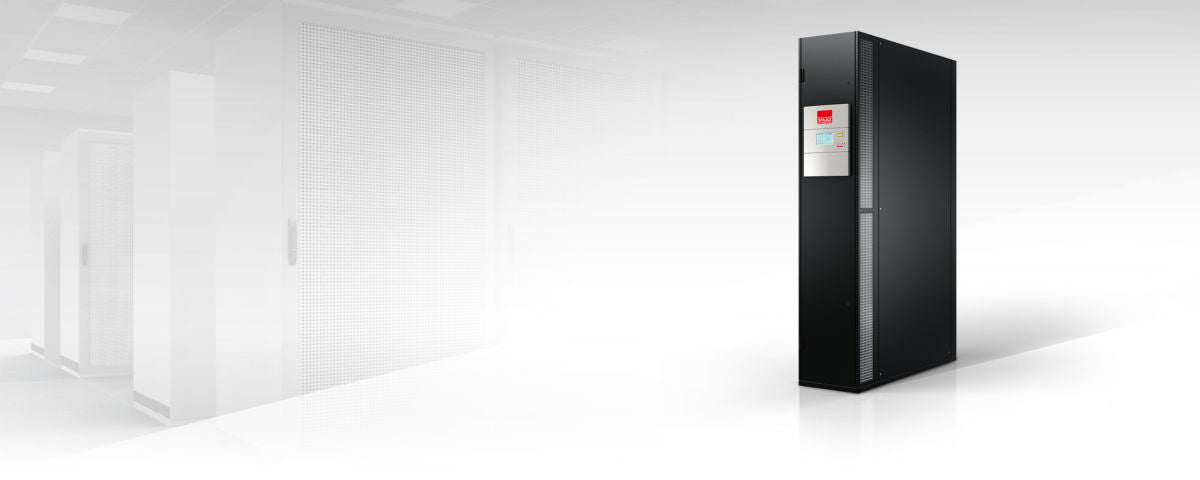
The STULZ CyberRow is an in row cooling unit that stands directly between the server racks, delivering 11 kW to 58 kW of cooling and 3,200 to 11,200 cubic metres per hour of airflow to high density racks in Australian data centres, with or without a raised floor. Each unit cools up to six server cabinets, uses horizontal air conduction to build a virtual containment around the racks it serves, and regulates three separate horizontal zones with up to five independently variable EC fans. Indigi Power and Cooling supplies, installs, commissions and maintains CyberRow in row cooling units nationally from hubs in Brisbane, Sydney and Melbourne.
Rack densities have moved. A data hall designed a decade ago sized 3 kW to 5 kW per cabinet and pushed cold air out of a floor void to the room at large. A hall carrying GPU compute, virtualisation clusters or dense blade chassis now routinely sees 15 kW, 25 kW or more in a single cabinet, and a room level cooling strategy simply cannot deliver enough air to the front of those racks fast enough. The result is a hot spot: one or two cabinets running well above the rest of the hall while the perimeter CRAC units work hard and over supply everything else.
In row cooling solves that by shortening the air path. The CyberRow is a narrow cabinet, 300 mm, 400 mm or 600 mm wide and 1,950 mm high, that is bolted into the row alongside the racks it serves. Air travels metres rather than tens of metres, and because the unit is measuring temperature at the racks themselves rather than at a return grille on the wall, it responds to what the servers are actually experiencing. STULZ describes the CyberRow as professional server rack cooling with innovative air conduction, and the design intent shows in the details: horizontal air distribution, up to five independent fans, and six temperature sensors across the front and rear faces.
Indigi Power and Cooling is an Indigenous and Veteran owned critical power and cooling specialist, registered with Supply Nation and ICN Gateway. We supply, install, commission and maintain STULZ in row cooling across Australia, and we also service the installed base of in row and perimeter equipment already running in Australian facilities, including units from other manufacturers.
See the CyberRow in operation
STULZ CyberRow (english), 3 minutes 4 seconds. Walks through the housing, filter, fan arrangement, service access and connection options.
Why the CyberRow suits high density rack cooling
Six cabinets per unit
STULZ rates each CyberRow at up to six server cabinets. Cooling is targeted at the racks in the row rather than diluted across the whole white space.
No raised floor required
The unit is suitable for data centres with or without a floor void, which removes the single biggest obstacle to retrofitting cooling into an existing comms room.
Three zone regulation
Up to five variable speed EC fans and six temperature sensors adapt cooling capacity in three horizontal zones, so a hot top of rack is fixed without over cooling the bottom.
Virtual containment
The optimised horizontal air pattern creates a virtual containment around the served racks even where no physical aisle enclosure has been built.
Any rack manufacturer
No direct cable or refrigerant connection is required between rack and unit, so the CyberRow drops into rows of any brand of cabinet with real installation flexibility.
Front and rear service access
Doors front and rear, a pivoting electrical box and a zigzag G4 filter in a metal frame mean maintenance happens from the aisle without pulling the unit out of the row.
Range specification at a glance
| Parameter | Specification |
|---|---|
| Total cooling capacity | 11 kW to 58 kW |
| Airflow volume | 3,200 to 11,200 cubic metres per hour |
| Racks cooled per unit | Up to six server cabinets |
| Sizes | 6 sizes, 3 widths and 2 depths |
| Height | 1,950 mm across the range |
| Width | 300 mm, 400 mm or 600 mm |
| Depth | 1,175 mm or 1,200 mm (CRS short), 1,375 mm (CRL long) |
| Rack footprints referenced | 1,200 / 1,000 / 600 / 400 / 300 mm |
| Air conduction | Left and right, to the left, to the right, or forward (frontal) |
| Cooling systems | A/AS air cooled, GS water cooled, GES hybrid Free Cooling, CW and CW2 chilled water |
| Refrigerants | R410A (GWP 2,088), R134a (GWP 1,430) |
| Fans | Up to five independent variable speed EC fans in three horizontal zones |
| Compressor | Variable speed EC compressor with integrated soft start (AS, GS, GES) |
| Filtration | Zigzag G4 filter with metal frame, accessible from the aisle |
| Control and BMS | STULZ controller, six temperature sensors, two independent setpoints, RS-485 serial port standard for Modbus and STULZ protocols |
Model table: CyberRow DX and hybrid Free Cooling
| Model | Airflow m³/h | Cooling kW | Indirect Free Cooling kW | Height mm | Width mm | Depth mm |
|---|---|---|---|---|---|---|
| CRS/CRL 101 A | 3,200 | 11.4 | n/a | 1,950 | 300 | 1,200 or 1,375 |
| CRS/CRL 211 A | 4,600 | 20.3 | n/a | 1,950 | 300 | 1,200 or 1,375 |
| CRS/CRL 211 AS | 4,600 | 22.0 | n/a | 1,950 | 300 | 1,200 or 1,375 |
| CRS/CRL 251 A/AS/GS | 5,400 | 25.0 | n/a | 1,950 | 400 | 1,175 or 1,375 |
| CRS/CRL 361 A/AS/GS | 8,000 | 37.0 | n/a | 1,950 | 600 | 1,175 or 1,375 |
| CRS/CRL 251 GES | 5,400 | 25.0 | 21.5 | 1,950 | 400 | 1,175 or 1,375 |
| CRS/CRL 361 GES | 8,000 | 37.0 | 30.9 | 1,950 | 600 | 1,175 or 1,375 |
The 11 kW to 58 kW headline range covers the whole CyberRow family. The DX and hybrid Free Cooling models tabled above run from 11.4 kW to 37 kW at the stated return air condition; the top of the range and the 11,200 cubic metre per hour airflow figure are reached on CW and CW2 chilled water configurations. Ratings move with return air temperature, humidity and chilled water flow and temperature, so treat the table as a selection starting point and let us run the numbers against your actual conditions.
Hot aisle and cold aisle containment
Containment is where in row cooling either works properly or quietly fails. The point of any containment scheme is to stop cold supply air and hot exhaust air mixing, because every degree of mixing is capacity you paid for and did not deliver to a server inlet. The CyberRow supports both of the standard containment strategies, and the correct choice drives which air conduction option you order.
Cold aisle containment
Units with a frontal air outlet blow straight down the enclosed cold aisle. STULZ positions them at an offset to one another so the whole aisle is supplied rather than just the neighbouring cabinets, which evens out inlet temperatures along the run.
Hot aisle containment
Units with side air conduction take return air from the contained hot aisle and expel cold air sideways into the room, which distributes supply air uniformly along the length of the aisle instead of concentrating it in front of one or two cabinets.
Where no physical containment has been built, the CyberRow still improves on room level cooling because the optimised horizontal air pattern forms what STULZ calls a virtual containment. Cold air is thrown along the front of the rack line and hot air is collected close to where it is produced, so the mixing that normally occurs in an open hall is substantially reduced without erecting doors and roof panels. That matters in Australian comms rooms and small data halls where the room is shared, the ceiling is low, or the building owner will not permit structural aisle work.
Three zone control and Delta T regulation
A tall cabinet does not have one temperature. The top of a 42U rack running dense compute is frequently several degrees warmer than the bottom, and a cooling unit that reads a single average will either starve the top or over cool the whole rack to protect it. The CyberRow addresses this with three temperature sensors on the front, three on the back, and up to five independently variable EC fans.
The controller measures Delta T between supply and return across each of three horizontal zones and adapts cooling capacity in each zone individually. In practice one fan bank may sit at 42 per cent while the two above it run at 65 and 67 per cent, because that is what the racks in front of them are asking for. Hot spots are removed without the energy penalty of an across the board over supply, and because EC fan power varies roughly with the cube of speed, small reductions in fan duty produce disproportionately large savings on a 24 hour a day load.
The controller also carries two mutually independent setpoints, typically a fixed supply air setpoint and a fixed Delta T setpoint between supply and return air. Holding both at once is what allows precise temperature control at the server inlet while still managing the volume of air moved, rather than trading one against the other. STULZ develops the controller in house, which is why the Free Cooling operating modes, the zone logic and the fan redundancy behaviour are handled as one integrated control strategy rather than bolted together from third party parts.
Fan redundancy is worth calling out separately. If a fan fails, the remaining fans automatically speed up to hold capacity, so a single fan fault does not become a thermal event while a technician is dispatched. The controller monitors and reports all faults, and a standard RS-485 serial port allows integration into a building management system over Modbus or STULZ protocols. Optional humidity sensor, electric heater and humidifier are available where the room needs active humidity control as well as sensible cooling.
Choosing between the cooling systems
| System | Description | Typical fit |
|---|---|---|
| A / AS | Air cooled direct expansion with an external air cooled condenser. AS adds the variable speed EC compressor with integrated soft start. | Server rooms and small data halls with roof or ground level condenser space and no chilled water plant. |
| GS | Water cooled. Heat is transferred to a water or glycol circuit and rejected through an external dry cooler. | Multi tenant buildings and long pipe runs, where refrigerant charge and pipe length need to be minimised. |
| GES | Hybrid Free Cooling with Indirect Dynamic Free Cooling. Rated at 21.5 kW (251) and 30.9 kW (361) in Free Cooling mode. | Melbourne, Canberra, Hobart and inland New South Wales sites chasing the lowest annual running cost. |
| CW | Chilled water. No compressor in the unit; capacity comes from the building chilled water plant. | Facilities already on central chilled water, and the route to the top of the capacity range. |
| CW2 | Chilled water with a redundant supply. One unit connects to two independent chilled water circuits. | Sites that need cooling to survive the loss of one chilled water circuit without installing a second unit. |
CW2 deserves a note of its own, because redundancy at the unit is usually cheaper and simpler than redundancy at the row. Connecting a single CyberRow to two mutually independent chilled water circuits means a ruptured pipe, a failed pump or a valve isolation on one circuit does not take that unit offline. For a facility working to an APRA CPS 230 style operational resilience obligation, that is a materially easier story to write up than an N+1 argument that depends on neighbouring units picking up a failed unit's load.
Installation detail that matters on site
Several CyberRow design decisions exist specifically to make the retrofit case work. There is no direct cable or refrigerant connection between the rack and the cooling unit, so the unit can be positioned wherever the thermal model wants it without being tied to a particular cabinet. Water connection openings are pre cut as standard at both the top and the bottom of the cabinet, which means the same unit suits an overhead reticulation design or an under floor one without site fabrication. The housing is powder coated with doors front and rear, and the electrical box pivots out for service, so a technician working in a live aisle is not forced to break containment or shut down a neighbouring rack to reach a component.
The zigzag G4 filter sits in a metal frame and is changed from the aisle. On a continuously running unit the filter is the most common cause of a gradual, unnoticed capacity loss, so filter change intervals should be set against the actual dust load of the room rather than a generic annual schedule. Rooms in industrial estates, near construction, or on sites with regular door traffic will need shorter intervals than a sealed CBD comms room.
Applications
- High density rack cooling for AI and GPU compute, where a handful of cabinets carry far more load than the rest of the hall
- Retrofit cooling into existing server rooms and comms rooms that have no raised floor and no room for a perimeter unit
- Hot aisle or cold aisle containment pods inside a larger colocation or enterprise data hall
- Targeted supplementary cooling alongside existing perimeter CRAC units, resolving hot spots without resizing the whole plant
- Modular and phased build outs, where cooling capacity is added row by row as racks are populated
- Chilled water facilities needing unit level redundancy through CW2, complementing CHW CRAC arrangements
- Combined critical power and cooling projects delivered as server room UPS and cooling packages
CyberRow compared with Vertiv Liebert CRV
| Attribute | STULZ CyberRow | Vertiv Liebert CRV |
|---|---|---|
| Format | In row cabinet 300, 400 or 600 mm wide, 1,950 mm high, sitting directly between racks | In row cabinet in comparable narrow widths, also designed to sit in the rack line |
| Capacity band | 11 kW to 58 kW total | Broadly comparable in row band, published by model and rating condition |
| Zone control | Three horizontal zones, up to five independently variable EC fans, six temperature sensors | Variable speed EC fans with multiple sensors; zoning behaviour differs by model and control version |
| Chilled water redundancy | CW2 connects one unit to two independent chilled water circuits | Dual circuit options available on selected configurations; confirm per model |
| Free Cooling | GES hybrid with Indirect Dynamic Free Cooling, 21.5 kW and 30.9 kW Free Cooling ratings | Economiser strategies generally handled at the chilled water plant rather than in the in row unit |
| Service access | Front and rear doors, pivoting electrical box, aisle side filter change | Front and rear access on most configurations |
| Australian service | Indigi Power and Cooling, national coverage from Brisbane, Sydney and Melbourne | Indigi also services Vertiv and Liebert equipment. See our Liebert spare parts page. |
Installation, commissioning and maintenance in Australia
A CyberRow deployment is a licensed job on two fronts. Electrical work must be carried out by a licensed electrician to AS/NZS 3000, and any work on the refrigerant circuit of an A, AS, GS or GES unit requires an ARCtick licensed refrigeration technician under the Ozone Protection and Synthetic Greenhouse Gas Management Regulations. Where the installation forms part of a mechanical ventilation system, AS/NZS 3666 hygiene obligations apply to the air handling components and to the cleaning and inspection regime. Indigi handles all of this in house rather than subcontracting the critical path.
Typical scope covers heat load verification against the actual IT draw rather than nameplate figures, rack by rack load mapping so the number and placement of units is right, air conduction selection to match the containment strategy, chilled water or refrigerant pipe design and dry cooler or condenser siting, rigging into a live aisle, controller configuration, BMS integration over Modbus on the standard RS-485 port, and witness commissioning with documented handover. We measure server inlet temperatures at commissioning and confirm they sit within the ASHRAE TC 9.9 recommended envelope of 18 to 27 degrees Celsius, because that is the number an auditor or a hardware vendor will ask about, not the unit's supply air temperature.
Indicative pricing for server room cooling design and installation runs from $8,000 to $15,000 for small rooms, $25,000 to $45,000 for medium installations and $45,000 to $60,000 plus for large projects. A typical in row retrofit of two to four CyberRow units into an existing row, including pipework and controls integration, usually lands in the medium band. Quoted scope always depends on the site, the pipe run and how much work has to happen out of hours.
Once running, the unit needs a maintenance regime that reflects continuous duty. The schedule should cover filter condition and replacement, coil cleanliness, condensate management, refrigerant charge and leak checks on DX models, chilled water valve and actuator operation on CW and CW2 models, fan bearing and EC fan health across all five fans, controller alarm history, and verification that the zone sensors are still reading correctly after any rack moves. See our CRAC unit maintenance services, DX CRAC servicing and CDW CRAC servicing pages for how we structure this.
Frequently asked questions
What is in row cooling and when should you use it?
In row cooling places the cooling unit directly in the rack line, between the server cabinets, instead of at the perimeter of the room. It shortens the air path so cold air reaches the server inlet before it mixes with hot exhaust air, and it lets the unit measure and respond to temperatures at the racks themselves. Use it where rack densities are high, where a hot spot has appeared that perimeter units cannot resolve, or where there is no raised floor to distribute air through.
How many server racks can one STULZ CyberRow unit cool?
STULZ rates each CyberRow unit at up to six server cabinets. The actual number depends on the load per cabinet, the containment arrangement and the air conduction option selected. A row of low density cabinets at 4 kW each is a very different selection to three cabinets carrying 15 kW of GPU compute, so the unit count should always come from a rack by rack load map rather than a rule of thumb.
Does the STULZ CyberRow need a raised floor?
No. The CyberRow is suitable for data centres and server rooms with or without a raised floor, because air is distributed horizontally along the row rather than through a floor void. Water connection openings are pre cut as standard at both the top and the bottom of the cabinet, so overhead and under floor reticulation are both supported without site fabrication.
What cooling capacity does the STULZ CyberRow deliver?
The range covers 11 kW to 58 kW of total cooling capacity with airflow from 3,200 to 11,200 cubic metres per hour, across six sizes in three widths of 300, 400 and 600 mm and two depths. The DX and hybrid Free Cooling models run from 11.4 kW on the CRS/CRL 101 A to 37 kW on the CRS/CRL 361, measured at return air of 35 degrees Celsius and 25 per cent relative humidity. The top of the range is reached on CW and CW2 chilled water configurations.
How does the CyberRow work with hot aisle and cold aisle containment?
Units with a frontal air outlet are used for cold aisle containment and are positioned at an offset to one another so the whole cold aisle is supplied rather than only the neighbouring racks. Units with side air conduction are used for hot aisle containment, expelling cold air sideways for uniform distribution along the length of the aisle. Where no physical containment exists, the optimised horizontal air pattern still creates a virtual containment around the racks the unit serves.
What happens if a fan fails in a STULZ CyberRow?
If one fan fails, the remaining fans automatically increase speed to maintain cooling capacity, so a single fan fault does not become a thermal event while a technician is dispatched. The STULZ controller monitors and reports all faults, and alarms can be passed to a building management system through the standard RS-485 serial port using Modbus or STULZ protocols.
Who supplies and services STULZ in row cooling units in Australia?
Indigi Power and Cooling supplies, installs, commissions and maintains STULZ CyberRow in row cooling units across Australia from hubs in Brisbane, Sydney and Melbourne. Electrical work is carried out to AS/NZS 3000 and all refrigerant work by ARCtick licensed technicians. We also service existing in row and perimeter cooling units installed by others, including Vertiv and Liebert equipment.
Where we install and service
Brisbane and QLD
Brisbane CBD, Woolloongabba, Eight Mile Plains, Port of Brisbane, Gold Coast, Sunshine Coast, Ipswich, Townsville, Cairns
National HQ at Tingalpa. Fastest response for in row retrofits and hot spot remediation in South East Queensland.
Sydney and NSW
Sydney CBD, Parramatta, North Ryde, Macquarie Park, Western Sydney, Newcastle, Wollongong, Canberra (ACT)
Where the highest rack densities in the country sit. Most CW and CW2 chilled water in row selections come from this market.
Melbourne and VIC
Melbourne CBD, Port Melbourne, Docklands, Dandenong, Tullamarine, Geelong, Ballarat, regional Victoria
The strongest Free Cooling business case on the mainland. GES hybrid selections repay their premium fastest here.
Perth and WA
Perth CBD, Fremantle, Kalgoorlie, Pilbara, regional WA
Resources sector rooms with high ambient design conditions. Condenser and dry cooler sizing is the critical variable.
Adelaide and SA
Adelaide CBD, Port Adelaide, Salisbury, Mount Gambier, Whyalla, regional SA
Good Free Cooling hours through the cooler months, served from the Melbourne hub.
Darwin and NT
Darwin CBD, Palmerston, Katherine, Alice Springs, remote NT sites
High humidity design conditions. Latent load and condensate handling need specific attention at selection stage.
Western Australia, Tasmania and Pacific Islands: we schedule CyberRow installation and service visits in planned blocks to keep travel costs down, and we can combine in row cooling work with UPS and battery attendance in a single mobilisation. Contact us to discuss scheduling.
Related products and services
- CRAC unit maintenance services Australia
- CHW CRAC maintenance for chilled water in row and perimeter units
- DX CRAC servicing across Brisbane, Sydney and Melbourne
- CRAC installation and commissioning
- Server room cooling Australia
- Server room heat load calculator
- CRAC topology selector: DX, CHW or CDW
- Server room UPS and cooling packages
|
Get a CyberRow in row cooling selection for your racks Send us your rack layout, the load per cabinet, your containment arrangement and whether chilled water is available, and we will come back with a unit count, an air conduction selection and an installed price. Indigi Power and Cooling is Indigenous and Veteran owned, and registered with Supply Nation and ICN Gateway. Contact Indigi Power and Cooling |

Partner with Us
Reliable Power & Cooling Solutions from Indigi Power & Cooling Expert supply, installation, and contracting services for critical infrastructure across Australia.