

STULZ SplitAir Split System Container and Shelter Cooling Australia
STULZ SplitAir Split System Container and Shelter Cooling Australia
Home / Precision Cooling / STULZ / Shelter and Container Cooling / SplitAir
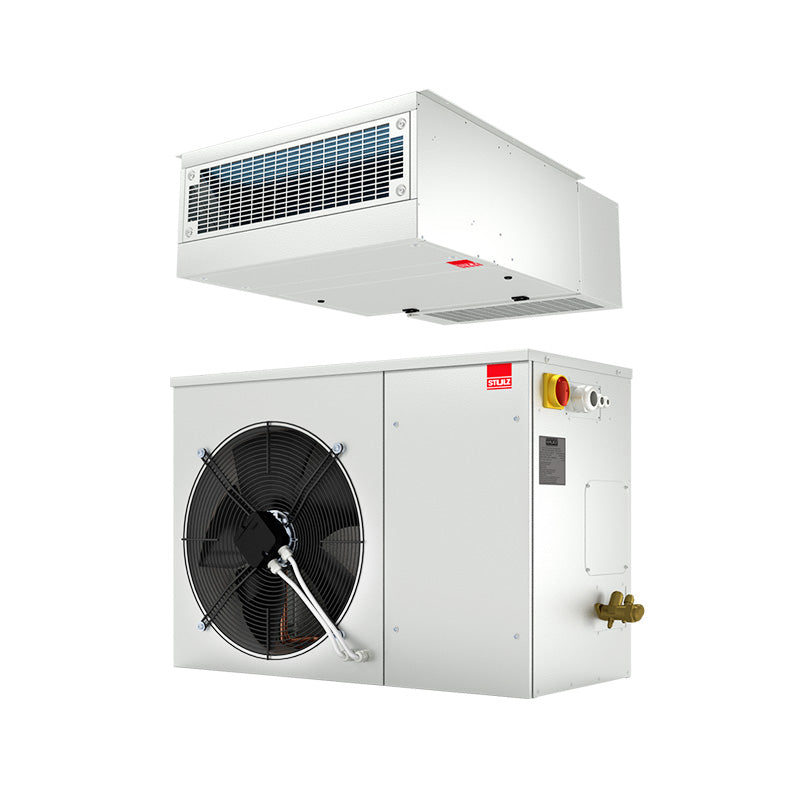
The STULZ SplitAir is a split system air conditioner for telecommunication containers and equipment shelters, delivering 5 kW to 16 kW of cooling from an indoor evaporator unit paired with a separate outdoor condensing unit, and it is supplied and serviced across Australia by Indigi Power and Cooling. Because the refrigeration and heat rejection hardware sits outside on its own condensing unit, the indoor section is shallow enough to retrofit into a container or hut that has no room for a full depth self-contained cooler. STULZ rates the Direct Free Cooling function at up to 83 per cent savings on running costs, and the unit will keep running on 48 V DC or 230 V single phase backup when the main supply fails.
A telecommunication container, a rail signalling hut or a base station shelter is a small sealed box with a continuous heat load and nobody in it. That combination is unforgiving. The equipment inside runs every hour of every year, the enclosure has almost no thermal mass, and if the cooling stops the internal temperature climbs fast enough to trip battery chargers, transmission gear and edge compute nodes within an hour. The SplitAir is built for exactly that duty, and it is the split system member of the STULZ shelter cooling family.
The split arrangement is the point of difference. Rather than one box that carries evaporator, compressor and condenser together, the SplitAir separates the indoor evaporator unit from an outdoor condensing unit connected by a refrigerant line set. That matters in two situations that come up constantly in Australia. The first is a retrofit, where an existing container has cable trays, battery racks or a distribution board occupying the wall where a full depth unit would have to go, and the only viable indoor footprint is 350 mm to 410 mm deep. The second is an aesthetics or security constraint, where a council, a landlord or a site owner will not accept a large penetration and a bulky unit hanging off the outside face of the shelter, but will accept a condensing unit sitting on a plinth or a bracket at ground level.
Indigi Power and Cooling is an Indigenous and Veteran owned critical power and cooling specialist, registered with Supply Nation and ICN Gateway. We supply, install, commission and maintain STULZ shelter and container cooling equipment nationally from hubs in Brisbane, Sydney and Melbourne, and we service existing units that were installed by others.
See STULZ shelter and container cooling in operation
STULZ Shelter Cooling (english), 2 minutes 47 seconds. This film covers the full STULZ shelter and container cooling range, not the SplitAir alone, so you will see wall mounted, indoor and cabinet units alongside the split system.
Why the SplitAir suits container and shelter retrofits
Split system, shallow indoor unit
Indoor evaporator depth is 885 mm to 1,370 mm and height only 350 mm to 410 mm, because the compressor and condenser live outside. It fits where a full depth self-contained unit will not.
Up to 83 per cent running cost saving
STULZ rates Direct Free Cooling on the SplitAir at up to 83 per cent savings on running costs against compressor only operation, by drawing filtered outside air whenever it is cool enough to do the work.
Backup operation on mains failure
On loss of the main power supply the unit continues in Free Cooling and backup cooling mode from 48 V DC or 230 V, 50 Hz, single phase. Cooling rides through the outage with the transmission load.
Minus 20 to plus 50 degrees ambient
Standard outside air range is minus 20 degrees Celsius in winter to plus 50 degrees Celsius in summer. An optional winter kit extends to minus 40, and R513A high temperature operation reaches 55 degrees Celsius.
Low refrigerant charge
Charge is held below ten tonnes of CO2 equivalent, with a hermetically sealed circuit as standard on EC compressor models. Less charge means less to lose, less to recover and less to report.
Remote monitoring built in
SEC.blue control with monitoring and remote access over a web interface, inside and outside temperature sensors, filter monitor and airflow alarm. Unmanned sites are visible without a truck roll.
Headline specification
| Parameter | Specification |
|---|---|
| System type | Split system, indoor evaporator unit plus separate outdoor condensing unit |
| Cooling capacity | 5 kW to 16 kW (published model data 5.4 kW to 15.7 kW) |
| Airflow volume | 1,110 to 3,300 cubic metres per hour |
| Sizes | 2 sizes, size 1 and size 2, across eight model codes |
| Free Cooling | Direct Free Cooling with filtered outside air. STULZ rates the saving at up to 83 per cent on running costs. |
| Refrigerants | R410A (GWP 2,088) with EC compressor, R407C (GWP 1,774) with On/Off compressor, R513A (GWP 631) for high temperature operation |
| Refrigerant charge | Below ten tonnes CO2 equivalent. Hermetically sealed circuit standard with EC compressor, optional with On/Off. |
| Outside air conditions | Minus 20 degrees Celsius winter to plus 50 degrees Celsius summer. Optional winter kit to minus 40. Optional high temperature operation to 55 degrees Celsius with R513A. |
| Backup operation | Free Cooling and backup cooling on failure of the main supply, from 48 V DC or 230 V / 50 Hz / 1 Ph |
| Filtration | Zigzag filter, ISO 16890 ePM10 50 per cent, with filter monitor and airflow alarm |
| Condenser | Microchannel technology, with condensation pressure control |
| Control system | SEC.blue, with monitoring and remote access via a web interface, inside and outside temperature sensors |
| Electrical | Compressor soft start for low start-up currents, plug and play wiring with connector |
| Options | External operator terminal, electric heater, humidity sensor, winter kit, high temperature operation |
SplitAir model table
| Model | Cooling capacity kW | Size | Compressor |
|---|---|---|---|
| SXL40 | 5.4 | 1 | On/Off |
| SXL60 | 6.7 | 1 | On/Off |
| SXL80 | 8.4 | 1 | On/Off |
| SXLA0 | 11.4 | 2 | On/Off |
| SXLA2 | 13.5 | 2 | On/Off |
| SXLA5 | 15.7 | 2 | On/Off |
| SNL80 | 8.1 | 1 | EC |
| SNLA5 | 13.0 | 2 | EC |
How to read a SplitAir model code
The SplitAir code is three letters followed by a two character capacity code. The letters tell you the compressor type, the capacity code tells you the nominal kilowatt rating. Once you know the pattern you can size and cross reference a unit from the nameplate alone, which is useful when you arrive at an unfamiliar shelter with nothing but the label on the indoor unit to work from.
| Code element | Meaning |
|---|---|
| SXL | On/Off compressor |
| SNL | EC compressor |
| 40 | 4 kW nominal capacity |
| 60 | 6 kW nominal capacity |
| 80 | 8 kW nominal capacity |
| A0 | 10 kW nominal capacity |
| A2 | 12 kW nominal capacity |
| A5 | 15 kW nominal capacity |
Indoor and outdoor unit dimensions
The indoor evaporator comes in two installation variants. Variant 2 is the deeper arrangement, variant 3 is the shorter one, and the choice usually comes down to how much clear wall length the container has and where the line set can penetrate. Both variants are the same height, which is the number that decides whether the unit clears a cable tray or a doorway.
| Component | Size 1 | Size 2 |
|---|---|---|
| Indoor unit, variant 2 | 850 x 350 x 1,160 | 1,040 x 410 x 1,370 |
| Indoor unit, variant 3 | 850 x 350 x 885 | 1,040 x 410 x 1,035 |
| Outdoor condensing unit | 973 x 715 x 508 | 973 x 1,334 x 513 |
Direct Free Cooling and the 83 per cent claim
Direct Free Cooling is the reason this unit exists in its current form. Instead of running the compressor whenever the shelter is above setpoint, the SplitAir opens a damper and pulls filtered outside air through the enclosure whenever the outside air is cold enough to carry the heat load on its own. The compressor stays off. Fan power replaces compressor power, and fan power on a unit of this size is a small fraction of it. STULZ rates the result at up to 83 per cent savings on running costs compared with mechanical cooling alone.
How much of that 83 per cent a given Australian site actually banks depends almost entirely on where it is and what internal temperature the equipment owner will accept. Shelters are usually allowed to run warmer than a data hall, often in the high twenties or low thirties, and that generous setpoint is what makes Free Cooling productive here. A signalling hut in the Southern Highlands, an exchange building in Ballarat or a base station in the Central Tablelands will spend a large share of the year with ambient temperatures below the changeover point. A shelter in Darwin, Karratha or Mount Isa will spend far less, but even there the overnight hours in the dry season are worth capturing.
The trade off is that outside air enters the enclosure, so it has to be filtered and the filtration has to be monitored. The SplitAir uses a zigzag filter rated ISO 16890 ePM10 50 per cent, which removes half of particles up to ten micrometres, and it pairs that with a filter monitor and an airflow alarm so a blocked filter raises a fault rather than quietly strangling the airflow. On dusty inland sites, unsealed access roads and mine haul routes, filter interval is the single most important maintenance variable and it should be set from observed differential pressure rather than from a calendar.
Condensation pressure control keeps the refrigerant circuit stable when the compressor does have to run at low ambient temperatures. Without it, head pressure collapses on a cold night and the expansion device loses control of superheat. This is the detail that separates equipment designed for continuous outdoor duty from equipment designed for an office wall.
Backup operation when the main supply fails
Most container and shelter loads are already backed by a DC plant. The transmission equipment, the routers and the alarms all keep running from the 48 V battery string when mains power drops. The cooling usually does not, which is the weak link. A sealed shelter with a live heat load and no air movement heats up quickly, and the outage that the batteries were meant to ride through instead becomes a thermal shutdown.
The SplitAir addresses this directly. On failure of the main power supply the unit switches to backup operation and continues to provide Free Cooling and backup cooling from either 48 V DC or a 230 V, 50 Hz, single phase source. That means the same battery plant that keeps the radio alive also keeps air moving through the enclosure, and the site rides out a distribution fault, a storm outage or a generator changeover without an equipment room temperature alarm.
For operators working to a formal resilience obligation, and that increasingly includes utilities, transport authorities and any organisation caught by APRA CPS 230 operational risk expectations, this is a documented control rather than an assumption. It is worth writing the backup cooling mode into the site's outage procedure and testing it during commissioning, not discovering it during the first real event.
Refrigerant charge and Australian regulation
STULZ designs the SplitAir with a low refrigerant quantity, below ten tonnes of CO2 equivalent, and offers a hermetically sealed refrigerant circuit as standard with the EC compressor and as an option with the On/Off compressor. In the European market that combination removes the requirement for an annual leak test under the EU F-gas Regulation.
That specific exemption does not apply in Australia, and it should not be quoted as though it does. The Australian regime is different. Synthetic greenhouse gas refrigerants are controlled under the Ozone Protection and Synthetic Greenhouse Gas Management Act 1989 and its regulations, administered by the Department of Climate Change, Energy, the Environment and Water. Anyone handling refrigerant needs a Refrigerant Handling Licence issued by the Australian Refrigeration Council, commonly called an ARCtick licence, and any business acquiring, storing or disposing of refrigerant needs a Refrigerant Trading Authorisation. There is no blanket annual leak test mandated the way there is in Europe, but there is a legal obligation to prevent emissions, and site or contract level requirements often impose their own inspection schedule.
What the low charge and sealed circuit do buy an Australian operator is a smaller compliance and leak check burden in practice. Less refrigerant on site means a lower quantity to account for, a smaller recovery volume at end of life, less exposure to refrigerant price movements as higher GWP gases are phased down under the HFC import quota, and a smaller consequence if a leak does occur. The refrigerant choice matters here too. R513A carries a GWP of 631 against 2,088 for R410A and 1,774 for R407C, so specifying the high temperature R513A variant on a hot inland site delivers a lower GWP charge as well as a wider operating envelope.
Control, monitoring and remote access
The SplitAir runs on the STULZ SEC.blue control system with inside and outside temperature sensors as standard. The outside sensor is not decoration. Free Cooling changeover is a comparison between the two, so an incorrectly sited or sun exposed outdoor sensor will cost real money by suppressing Free Cooling hours. Site it in shade, on the cool side of the shelter, away from the condensing unit discharge.
Monitoring and remote access are provided over a web interface, which is the practical requirement for an unmanned asset. Temperature trends, alarm state, filter status and Free Cooling versus compressor hours can all be read without a site visit, and that history is what tells you whether a unit is genuinely healthy or is quietly running the compressor for hours it should not need to. An external operator terminal is available as an option where the site needs a local display outside the enclosure, along with an electric heater for cold climate installations and a humidity sensor where condensation risk is being managed actively.
SEC.blue control
Local display with room and external temperature, alarm indication and menu access. Available as an external operator terminal so the shelter does not have to be opened to check status.
Web interface monitoring
Remote access to temperatures, alarms, filter condition and operating mode across a fleet of shelters, so faults are triaged before a technician is dispatched.
Australian applications
- Telecommunication containers and equipment huts where the indoor wall depth will not take a full depth self-contained cooler
- Mobile network base station shelters, including tower sites reached by unsealed access roads where filter loading is heavy
- Rail signalling and interlocking equipment huts along regional corridors, where a thermal shutdown becomes an operational incident
- Remote mine site communications shelters in the Pilbara, Goldfields, Bowen Basin and North West Queensland, where the plus 50 degrees Celsius ambient rating and the R513A high temperature option both earn their place
- Water and power utility RTU and SCADA huts on pump stations, substations and reservoirs, which almost always already carry a 48 V DC plant the backup cooling mode can draw on
- Modular edge compute containers and micro data centres, where the split arrangement keeps the internal rack footprint intact. See our server room cooling and combined UPS and cooling pages
- Replacement of failed or end of life comfort splits in existing shelters, coordinated with installation and commissioning and ongoing maintenance
SplitAir compared with a conventional comfort split in the same shelter
The realistic alternative on most Australian shelter projects is not another purpose built shelter cooler. It is a domestic or light commercial comfort split, chosen because it is cheap, available and familiar to the local installer. The comparison below is the one worth having, because that is the decision most sites are actually making.
| Attribute | STULZ SplitAir | Conventional comfort split |
|---|---|---|
| Running cost | STULZ rates Direct Free Cooling at up to 83 per cent savings on running costs against compressor only operation | Compressor runs whenever the room is above setpoint, every hour of the year, including cool nights |
| Free Cooling hours | Automatic changeover on inside versus outside temperature. A large share of annual hours in southern and inland regions, a smaller but real share in the tropics. | None. There is no outside air path and no changeover logic. |
| Filtration | Zigzag filter to ISO 16890 ePM10 50 per cent, with filter monitor and airflow alarm | Washable mesh screen intended to protect the coil, not to clean incoming air, with no monitoring |
| Backup operation | Free Cooling and backup cooling continue on 48 V DC or 230 V single phase when the main supply fails | Stops on mains failure and will not restart until power returns, so the shelter heats up while the DC load keeps running |
| Ambient envelope | Minus 20 to plus 50 degrees Celsius standard, minus 40 with the winter kit, up to 55 degrees Celsius with R513A | Typically rated to the mid forties, with capacity and reliability falling away well before that in full sun |
| Monitoring | SEC.blue with web interface remote access, inside and outside sensors, filter and airflow alarms | Wall thermostat or infrared remote. Faults are usually discovered by a high temperature alarm from the equipment, not the cooler. |
| Expected service life | Designed for continuous duty in an unmanned enclosure, with condensation pressure control, compressor soft start and a serviceable component set | Designed for intermittent occupied hours duty. Continuous shelter service compresses the replacement cycle, and spares support ends when the model is superseded. |
Installation, commissioning and maintenance in Australia
A SplitAir installation is licensed work on two fronts. All electrical work must be carried out by a licensed electrician to AS/NZS 3000, including the supply to the outdoor condensing unit, the isolation arrangements and the 48 V DC or 230 V backup feed. Any work on the refrigerant circuit, which includes brazing, evacuation, charging and the final commissioning leak test, must be carried out by an ARCtick licensed refrigeration technician under the Ozone Protection and Synthetic Greenhouse Gas Management Act and its regulations. Where the shelter forms part of a mechanical ventilation system, the hygiene and cleaning obligations of AS/NZS 3666 also apply, and on a Direct Free Cooling unit that draws outside air into the enclosure they are worth taking seriously rather than treating as paperwork.
Typical scope on a container or shelter job covers a heat load check against the actual equipment draw rather than the nameplate rating, indoor unit position and variant selection against the available wall depth, outdoor condensing unit siting with attention to discharge clearance and reflected heat off the container skin, line set routing and penetration sealing, condensate management, plug and play electrical termination, SEC.blue configuration including the Free Cooling changeover points, web interface and alarm integration, and a witnessed commissioning test that includes a deliberate mains failure to prove backup operation.
Indicative pricing for cooling design and installation in the small band, which is where a single shelter or container project usually sits, runs from $8,000 to $15,000. Medium installations run $25,000 to $45,000 and large projects $45,000 to $60,000 plus. Multi site rollouts are quoted per site with mobilisation shared across the run, which is normally how a base station or signalling fleet programme is priced.
Ongoing maintenance for a shelter unit is short but non negotiable. Filter condition and differential pressure, coil cleanliness on both the indoor evaporator and the outdoor microchannel condenser, refrigerant charge and leak check, condensate drain and trap, damper operation and seal condition, backup mode function test, sensor calibration, and a review of the alarm and run hour history for the Free Cooling to compressor ratio. That last one is the cheapest diagnostic available. If Free Cooling hours drop year on year at the same site, something is wrong with a sensor, a damper or a filter long before it shows up as a failure. See our CRAC unit maintenance services and DX CRAC servicing pages for how we structure this work.
Frequently asked questions
What is the STULZ SplitAir?
The STULZ SplitAir is a split system air conditioner designed for Free Cooling in telecommunication containers and equipment shelters. It consists of an indoor evaporator unit and a separate outdoor condensing unit connected by a refrigerant line set, and it covers 5 kW to 16 kW of cooling capacity with airflow from 1,110 to 3,300 cubic metres per hour across two sizes and eight model codes.
How is the SplitAir different from other STULZ shelter cooling units?
The SplitAir is the split system in the range. The refrigeration and heat rejection hardware sits in a separate outdoor condensing unit rather than in the same box as the evaporator, which is why the indoor unit is only 350 mm to 410 mm high and 885 mm to 1,370 mm deep. Other units in the STULZ shelter family are single unit designs, either mounted on the outside wall or standing inside the shelter. Choose the SplitAir when the container has no room for a full depth unit, or when the outdoor face of the shelter cannot carry one.
How much can Direct Free Cooling save on running costs?
STULZ rates Direct Free Cooling on the SplitAir at up to 83 per cent savings on running costs compared with mechanical cooling alone. The actual saving at a given site depends on local climate, the internal temperature the equipment owner will accept and how many hours a year outside air is below the changeover point. Southern and inland Australian sites capture more of it than tropical coastal sites, but overnight hours are worth capturing everywhere.
Does the SplitAir keep cooling if the mains power fails?
Yes. On failure of the main power supply the SplitAir switches to backup operation and continues to provide Free Cooling and backup cooling from either 48 V DC or a 230 V, 50 Hz, single phase source. Because most telecommunication and utility shelters already have a 48 V DC battery plant supporting the equipment load, the cooling can ride through the same outage the equipment does. The backup mode should be function tested at commissioning.
Does the low refrigerant charge exempt the unit from leak testing in Australia?
No. The SplitAir holds less than ten tonnes of CO2 equivalent of refrigerant and offers a hermetically sealed circuit, which removes the annual leak test requirement under the EU F-gas Regulation, but that European exemption has no effect in Australia. Australian refrigerant handling sits under the Ozone Protection and Synthetic Greenhouse Gas Management Act, with ARCtick refrigerant handling licences and Refrigerant Trading Authorisations administered by the Australian Refrigeration Council. The low charge still reduces the practical compliance and leak check burden, and lowers recovery volumes and refrigerant cost exposure, but leak checking should be scheduled to your site and contract requirements.
What ambient temperatures can the SplitAir operate in?
Standard outside air conditions are minus 20 degrees Celsius in winter to plus 50 degrees Celsius in summer. An optional winter kit extends operation down to minus 40 degrees Celsius, and optional high temperature operation with R513A refrigerant extends the upper limit to 55 degrees Celsius. That upper band is the relevant one for inland and northern Australian sites in the Pilbara, the Goldfields, North West Queensland and the Northern Territory.
What does SNL80 mean in the SplitAir model code?
SNL80 is an EC compressor SplitAir with 8 kW nominal cooling capacity. The three letter prefix gives the compressor type, where SXL is an On/Off compressor and SNL is an EC compressor, and the two character suffix gives nominal capacity, where 40 is 4 kW, 60 is 6 kW, 80 is 8 kW, A0 is 10 kW, A2 is 12 kW and A5 is 15 kW. The SNL80 is rated at 8.1 kW at 30 degrees Celsius inside, 30 per cent relative humidity and 35 degrees Celsius outside.
Where we install and service
Brisbane and QLD
Brisbane CBD, Woolloongabba, Eight Mile Plains, Port of Brisbane, Gold Coast, Sunshine Coast, Ipswich, Townsville, Cairns
National HQ at Tingalpa. Split system shelter work across the coastal network and out to the Bowen Basin and North West Queensland mine communications huts.
Sydney and NSW
Sydney CBD, Parramatta, North Ryde, Macquarie Park, Western Sydney, Newcastle, Wollongong, Canberra (ACT)
Dense base station and rail signalling hut population. Regional corridor huts inland of the Divide return the strongest Free Cooling hours in the state.
Melbourne and VIC
Melbourne CBD, Port Melbourne, Docklands, Dandenong, Tullamarine, Geelong, Ballarat, regional Victoria
The best Direct Free Cooling business case on the mainland. A regional Victorian shelter spends most of the year below the changeover point.
Perth and WA
Perth CBD, Fremantle, Kalgoorlie, Pilbara, regional WA
Pilbara and Goldfields communications shelters. The R513A high temperature option and condensing unit shading are the two decisions that matter most here.
Adelaide and SA
Adelaide CBD, Port Adelaide, Salisbury, Mount Gambier, Whyalla, regional SA
Strong Free Cooling hours through the cooler months, with dust loading on Eyre and Yorke Peninsula sites driving the filter interval.
Darwin and NT
Darwin CBD, Palmerston, Katherine, Alice Springs, remote NT sites
High humidity in the Top End limits Free Cooling hours and raises the latent load, so condensate handling and setpoint selection need care. Alice Springs and the Barkly behave very differently.
Western Australia, Tasmania and Pacific Islands: shelter and container cooling visits are scheduled in planned blocks so travel is shared across multiple sites, and we can combine SplitAir service with DC plant and UPS work in a single mobilisation. Contact us to discuss scheduling.
Related products and services
- CRAC unit maintenance services Australia
- DX CRAC servicing across Brisbane, Sydney and Melbourne
- CRAC installation and commissioning
- Server room cooling Australia
- Server room UPS and cooling packages
- Server room heat load calculator
- CRAC topology selector: DX, CHW or CDW
- UPS, battery and CRAC maintenance in Brisbane
|
Get a SplitAir selection for your container or shelter Send us the equipment heat load, the internal dimensions and available wall depth, the site location and whether a 48 V DC plant is present, and we will come back with a sized model, an outdoor unit siting plan and an installed price. Indigi Power and Cooling is Indigenous and Veteran owned, and registered with Supply Nation and ICN Gateway. Contact Indigi Power and Cooling |
Partner with Us
Reliable Power & Cooling Solutions from Indigi Power & Cooling Expert supply, installation, and contracting services for critical infrastructure across Australia.