

STULZ WallAir Outdoor Wall Mounted Container Cooling Units Australia
STULZ WallAir Outdoor Wall Mounted Container Cooling Units Australia
Home / Precision Cooling / STULZ / Shelter and Container Cooling / WallAir
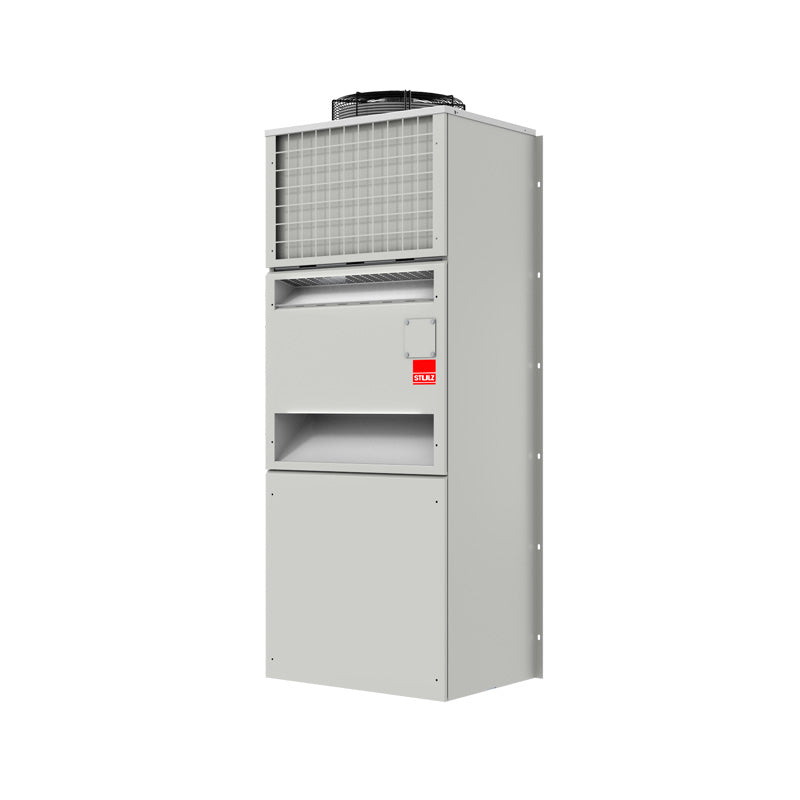
The STULZ WallAir is an outdoor wall mounted precision air conditioner for telecommunications shelters and equipment containers in Australia, delivering 4 kW to 16 kW of cooling from a weatherproof cabinet fixed entirely on the outside of the container wall, so it consumes zero internal floor or wall space. It is the Direct Free Cooling leader of the STULZ shelter range, rated by STULZ at up to 84 per cent savings on running costs, and it can be retrofitted into an existing container cutout using a universal adapter frame. Indigi Power and Cooling supplies, installs, commissions and maintains WallAir units nationally from hubs in Brisbane, Sydney and Melbourne.
Shelter cooling is a different engineering problem to server room cooling, and the constraint that drives it is space. A typical mobile network base station cabin, rail signalling hut or utility RTU enclosure is a steel box a few metres on a side, and by the time the racks, the battery string, the rectifier and the cable trays are in, there is no wall left to hang anything on and no floor left to stand anything on. The STULZ WallAir answers that constraint directly. The entire unit mounts on the outside face of the container wall. Nothing but the air openings and the adapter frame passes through the skin, and the internal footprint is zero.
That decision cascades through the rest of the design. Because the unit lives outdoors it has to be weatherproof and it has to survive being touched by people who have no business touching it, which matters at unstaffed roadside and trackside sites. Because it lives outdoors, the compressor and fan noise stays outside the shelter rather than inside it, which makes technician visits more tolerable and keeps sound pressure at the equipment racks low. And because the outside air is already right there at the coil face, the WallAir is the natural home for Direct Free Cooling. STULZ rates the WallAir at up to 84 per cent savings on running costs through Direct Free Cooling, which is the highest Free Cooling saving figure quoted anywhere in the STULZ shelter and container cooling range.
Indigi Power and Cooling is an Indigenous and Veteran owned critical power and cooling specialist, registered with Supply Nation and ICN Gateway. We supply, install, commission and maintain STULZ shelter cooling equipment across Australia, and we work on rollouts where the same unit is repeated across dozens or hundreds of remote sites, which is the usual pattern for telco, rail and utility shelter fleets.
See STULZ shelter cooling in operation
STULZ Shelter Cooling (english), 2 minutes 47 seconds. This video covers the full STULZ shelter and container cooling range, so it shows indoor and cabinet mounted units alongside the outdoor wall mounted WallAir.
Why the WallAir suits Australian shelters
Zero internal footprint
The whole cabinet hangs on the outside face of the container wall. No floor area, no internal wall run and no service clearance is taken from inside the shelter, so every internal millimetre stays available for racks and batteries.
Up to 84 per cent Free Cooling savings
STULZ rates Direct Free Cooling on the WallAir at up to 84 per cent savings on running costs. That is the highest Free Cooling figure in the STULZ shelter range, and it is a direct consequence of mounting the unit in the outside air.
Weatherproof by design
Built to sit permanently outdoors between minus 20 and plus 50 degrees Celsius, with an optional winter kit to minus 40 and optional high temperature operation to 55 degrees Celsius on R513A.
Universal adapter frame retrofit
A WallAir can be retrofitted without changing the existing container cutout. The universal adapter frame lets an ageing unit be swapped for a new WallAir without sheet metal work on site.
Low refrigerant charge
Charge is held below ten tonnes of CO2 equivalent, and the circuit is hermetically sealed as standard on EC compressor models and optional on On/Off models. Less charge means less to leak and less to reclaim.
Remote visibility
SEC.blue control with monitoring and remote access over a web interface, plus inside and outside temperature sensors, filter monitor and airflow alarm. Backup operation runs on 48 V DC or 230 V single phase.
WallAir headline specification
| Parameter | Specification |
|---|---|
| Product type | Outdoor air conditioner for Free Cooling in containers, mounted on the outside of the container wall |
| Cooling capacity | 4 kW to 16 kW |
| Sizes | 2 cabinet sizes covering the full capacity band |
| Air conduction | Displacement |
| Operating modes | Free Cooling, Mixed mode, Displacement, Upflow, Downflow |
| Free Cooling saving | Up to 84 per cent savings on running costs with Direct Free Cooling, as rated by STULZ |
| Refrigerants | R410A (GWP 2,088) with EC compressor, R407C (GWP 1,774) with On/Off compressor, R513A (GWP 631) for high temperature operation |
| Refrigerant charge | Less than ten tonnes CO2 equivalent. Hermetically sealed circuit standard with EC compressor, optional with On/Off |
| Outside air conditions | Minus 20 degrees Celsius winter to plus 50 degrees Celsius summer. Optional winter kit to minus 40. Optional high temperature operation to 55 degrees Celsius with R513A |
| Filtration | Zigzag filter, ISO 16890 ePM10 50 per cent, with filter monitor and airflow alarm |
| Condenser | Microchannel technology, with condensation pressure control |
| Control | SEC.blue, inside and outside temperature sensors, monitoring and remote access via web interface |
| Backup operation | 48 V DC or 230 V / 50 Hz / 1 Ph |
| Electrical connection | Plug and play wiring with connector, compressor soft start for low start-up currents |
| Options | External operator terminal, electric heater, humidity sensor, winter kit, universal adapter frame for retrofit |
WallAir model range
The table below lists the full WallAir range at the STULZ reference operating conditions. Note that the capacity you can rely on at an Australian summer design day will differ from the reference figure, so the selection should always be run against site specific outside design temperature rather than the table value.
| Model | Cooling capacity kW | Compressor | Size | W x H x D mm |
|---|---|---|---|---|
| WXD40 | 4.6 | On/Off | 1 | 879 x 2,137 x 565 |
| WXD60 | 6.1 | On/Off | 1 | 879 x 2,137 x 565 |
| WXD80 | 8.0 | On/Off | 1 | 879 x 2,137 x 565 |
| WXDA0 | 10.0 | On/Off | 2 | 992 x 2,192 x 730 |
| WXDA2 | 11.8 | On/Off | 2 | 992 x 2,192 x 730 |
| WXDA4 | 13.6 | On/Off | 2 | 992 x 2,192 x 730 |
| WXDA6 | 15.5 | On/Off | 2 | 992 x 2,192 x 730 |
| WND80 | 7.7 | EC | 1 | 879 x 2,137 x 565 |
| WNDA4 | 13.2 | EC | 2 | 992 x 2,192 x 730 |
| WNDA6 | 16.0 | EC | 2 | 992 x 2,192 x 730 |
Reading a WallAir model code
The model code is short and completely systematic, which is useful when you are reading an asset register or a decommissioning list rather than a brochure. It reads as WallAir, then compressor type, then airflow direction, then capacity.
| Position | Code | Meaning |
|---|---|---|
| First letter | W | WallAir, the outdoor wall mounted product family |
| Second letter | X or N | X is an On/Off compressor. N is an EC compressor, which modulates and carries the hermetically sealed circuit as standard |
| Third letter | D | Displacement air conduction |
| Capacity code | 40, 60, 80, A0, A2, A4, A6 | Nominal capacity in kW. 40 is 4 kW, 60 is 6 kW, 80 is 8 kW, A0 is 10 kW, A2 is 12 kW, A4 is 14 kW, A6 is 16 kW |
Size 1 cabinets measure 879 mm wide by 2,137 mm high by 565 mm deep. Size 2 cabinets measure 992 mm wide by 2,192 mm high by 730 mm deep. Because the cabinet sits outside the container, these dimensions are a site clearance question rather than an internal space question. What you need to confirm is the wall run available on the outside face, the depth clearance to any fence, hardstand edge or access path, and the load path into the container structure.
Outdoor mounting: what it actually changes
Two independent air paths are what make the arrangement work. The outside air circuit passes over the condenser and returns straight to atmosphere without ever entering the shelter. The internal air circuit draws warm air out of the container, passes it over the evaporator or the Free Cooling path, and returns it as a cool displacement stream low in the shelter. Only the two openings and the mounting frame penetrate the container wall.
Four practical consequences follow, and they are the reasons an engineer picks WallAir over an internally mounted unit.
Internal space. Nothing is consumed. On a shelter that has already been extended twice and now has racks on three walls, this is often the deciding factor. It also means the cooling can be upgraded later without a rack move, because the capacity increase happens on the outside face.
Noise inside the shelter. Compressor and condenser fan noise is generated outdoors. Inside the container you hear the displacement air stream and little else. On sites where a technician may spend several hours in a small steel box, that is a genuine work health and safety improvement, not a marketing point.
Weather and UV exposure. The unit is rated for continuous outdoor duty from minus 20 to plus 50 degrees Celsius as standard. In Australia the design questions are corrosion in coastal and near coastal locations, wind loading on cyclone exposed sites in northern Queensland, the Northern Territory and the Pilbara, and ultraviolet degradation of any exposed sealing or cable gland. All three are answerable at specification stage with the correct coating, fixing detail and cable entry, and all three should be raised before the order rather than after the first summer.
Vandalism and interference. An externally mounted unit is reachable, so unattended roadside, trackside and remote sites usually need a physical strategy around it. In practice that means siting the unit on the least accessible wall, adding a guard or cage where the site risk assessment calls for it, and using the SEC.blue remote monitoring to raise an alarm on airflow loss or filter blockage rather than waiting for a temperature alarm that arrives after the equipment has already throttled.
Retrofit without changing the container cutout
This is the commercial argument that matters most to Australian telco, rail and utility operators, because most of them are not building new shelters. They are maintaining a fleet of them, and the cooling units in that fleet are reaching the end of their service life at roughly the same time.
STULZ states that the WallAir can be retrofitted without changes to the container cutout, using a universal adapter frame for fast and easy replacement by a new WallAir model. That single sentence removes the most expensive and most uncertain part of a replacement job. Without an adapter frame, swapping a wall mounted unit for a different model normally means cutting, patching or re-framing the aperture in the container skin. That is hot work on a live site, it needs the shelter opened up, it needs a weatherproof detail rebuilt and re-sealed, and it usually needs a trade on site that is not the refrigeration technician.
With the adapter frame, the job reduces to isolate, disconnect, unbolt, lift off, fit frame, lift on, bolt up, reconnect, commission. The plug and play electrical connector helps here too, because the field wiring termination is a connector rather than a set of loose cores into a terminal rail. On a fleet replacement programme run across dozens of sites, the difference between a job that needs sheet metal work and one that does not is measured in whole days per site, and it changes the mobilisation plan entirely.
Three things are worth confirming before you commit to a fleet retrofit. First, the existing aperture dimensions and the structural condition of the wall around it, because an adapter frame solves geometry, not corrosion. Second, the available supply arrangement, since older shelters sometimes have a supply sized for a smaller or less efficient unit. Third, the intended backup arrangement, because the WallAir supports backup operation on 48 V DC or 230 V single phase and the choice affects how it integrates with the existing DC plant. Indigi surveys these three points as part of quoting a retrofit programme.
Direct Free Cooling and the 84 per cent figure
Direct Free Cooling means filtered outside air is used to cool the shelter directly, with the compressor off. It works in a shelter far more often than it works in a data hall, for a simple reason: the internal setpoint in a comms shelter is typically much higher than the 18 to 27 degrees Celsius server inlet band described in ASHRAE TC 9.9 for IT equipment. Telecommunications and utility equipment is frequently specified to run comfortably in the high twenties or low thirties, so the outside air only has to be a few degrees below that to do useful work. Across most of Australia, a large fraction of the year qualifies.
The WallAir moves through the operating modes automatically. In Free Cooling the outside air damper opens and the compressor stays off. In Mixed mode the compressor runs at part load to top up what the outside air cannot deliver. In full mechanical cooling the damper closes and the unit runs conventionally. STULZ rates the resulting saving at up to 84 per cent on running costs, which is the highest Free Cooling figure quoted in the STULZ shelter range and reflects how much of the year a well sited unit can avoid running its compressor at all.
Two design points determine whether you get near that number in practice. The first is filtration, because Direct Free Cooling brings outside air into the shelter. The WallAir uses a zigzag filter to ISO 16890 ePM10 50 per cent with a filter monitor and airflow alarm, which is appropriate for a shelter but does mean filter changes are a scheduled maintenance item rather than an afterthought, particularly on unsealed access roads, on mine sites and during bushfire smoke events. The second is the internal setpoint you are willing to hold. Every degree you relax the internal setpoint upward, within the equipment manufacturer's stated limits, adds Free Cooling hours to the year. That is a conversation between the network owner and the equipment vendor, and it is worth having before the cooling is specified.
Where outside air quality rules out a direct arrangement, or where the shelter has a tighter internal environment requirement, the correct answer is usually a different unit in the same STULZ range rather than a compromised WallAir selection. Indigi will say so at selection stage.
Control, monitoring and remote sites
SEC.blue control
The controller reads both inside and outside temperature, which is what makes the Free Cooling changeover decision possible. An external operator terminal is available as an option so the unit can be interrogated without opening the cabinet.
Remote access
Monitoring and remote access run over a web interface. On a distributed shelter fleet this is the difference between a planned visit and an emergency one, because filter and airflow alarms arrive before the internal temperature moves.
Two further details matter on remote Australian sites. Compressor soft start keeps start-up current low, which is relevant where the site is fed from a small transformer, a long rural feeder or a generator. And backup operation on 48 V DC or 230 V single phase means the cooling can be tied into the same DC plant that already backs the radio or SCADA equipment, so a mains outage does not immediately become a thermal event. Condensation pressure control keeps the refrigerant circuit stable when the outside temperature drops, which is what allows the unit to be used at the cold end of its range rather than only in summer conditions.
Refrigerant charge and Australian compliance
The WallAir carries a low refrigerant charge, held below ten tonnes of CO2 equivalent, and the circuit is hermetically sealed as standard on EC compressor models and available as an option on On/Off models. The STULZ brochure notes that this removes the requirement for the annual leak test under the European F-gas regulation.
That exemption is a European rule and it does not transfer to Australia. The applicable regime here is the Ozone Protection and Synthetic Greenhouse Gas Management Act and its regulations, administered through ARCtick licensing. Anyone handling refrigerant on a WallAir in Australia needs an ARCtick refrigerant handling licence, and the business doing the work needs a refrigerant trading authorisation to acquire, store or dispose of refrigerant. Do not assume the European leak test exemption applies to your Australian sites, because the two schemes are structured differently.
What the low charge and the sealed circuit do give you in Australia is a smaller compliance and leak-check burden in practical terms. There is less refrigerant to account for, less to recover at end of life, fewer field joints to inspect on a hermetically sealed circuit, and a smaller exposure if a leak does occur. On a fleet of dozens or hundreds of shelters that is a meaningful reduction in both cost and reporting effort, even though the licensing obligations themselves are unchanged. Refrigerant selection also matters here: R513A at GWP 631 carries roughly a third of the global warming potential of R410A at GWP 2,088 and is the option specified for high temperature operation up to 55 degrees Celsius.
Applications
- Mobile network base station shelters and cabins, where the internal wall is already fully occupied by radio, transmission and battery equipment
- Telecommunications huts and exchange annexes, including retrofit of ageing wall mounted cooling across an existing fleet
- Rail trackside signalling cabinets and equipment huts, where access windows are short and noise inside the hut matters to the technician
- Remote mine site communications shelters in the Pilbara, the Goldfields, central Queensland and the Northern Territory
- Water and power utility RTU and SCADA huts operating under APRA CPS 230 style resilience and continuity expectations at the customer end
- Modular edge compute containers and micro data centre pods, as a lighter alternative to full server room cooling where the load sits in the 4 kW to 16 kW band
- Sites where the cooling and the standby power are being reviewed together, covered on our server room UPS and cooling page
WallAir compared with TelAir
The closest comparison for a WallAir is not a competitor product. It is the TelAir, the indoor mounted unit in the same STULZ shelter range. Both cool the same kind of shelter and both offer Free Cooling, so the real decision is where the box goes. The table below sets out the trade.
| Attribute | STULZ WallAir | STULZ TelAir |
|---|---|---|
| Mounting position | Entirely on the outside face of the container wall, fixed through a wall cutout | Inside the shelter, against an internal wall |
| Internal space consumed | None. Zero internal footprint and no internal service clearance | Cabinet footprint plus front access clearance inside the shelter |
| Noise inside the shelter | Low. Compressor and condenser fan noise is generated outdoors | Higher. The full unit including the compressor sits in the occupied space |
| Weather and UV exposure | Fully exposed. Weatherproof construction, minus 20 to plus 50 degrees Celsius standard, coastal corrosion and wind loading to be specified | Protected by the shelter envelope. Corrosion and UV are not design drivers |
| Vandalism and interference | Physically reachable at unattended sites. Manage with siting, guarding and remote alarming | Protected by the shelter door and site security |
| Serviceability | Serviced from outside, so the shelter stays closed and the equipment stays undisturbed. Working at height or on a platform may apply on elevated mounts | Serviced from inside, at floor level, but the technician is working alongside live equipment in a confined space |
| Best fit | Space constrained shelters, retrofit of an existing wall cutout, and sites chasing the maximum Direct Free Cooling saving | Shelters with spare internal wall space, high vandalism risk, or severe external exposure |
Installation, commissioning and maintenance in Australia
A WallAir installation is licensed work on two fronts. All electrical work must be carried out by a licensed electrician to AS/NZS 3000, including the supply to the unit, the plug and play connector termination and any interface to the site DC plant for backup operation. All work on the refrigerant circuit requires an ARCtick licensed refrigeration technician under the Ozone Protection and Synthetic Greenhouse Gas Management Regulations. Where the WallAir forms part of a mechanical ventilation arrangement, and Direct Free Cooling means it often does, the hygiene obligations in AS/NZS 3666 apply to the outside air path, the filters and the condensate arrangement. Indigi carries out all three streams in house rather than subcontracting the critical path.
A typical installation scope covers heat load verification against the actual equipment draw rather than the nameplate, confirmation of the wall cutout and structural fixing detail, the adapter frame where the job is a retrofit, rigging and mounting, refrigerant charge check and leak test, electrical connection and isolation, SEC.blue configuration including the Free Cooling changeover strategy and alarm thresholds, remote access setup and testing, and witness commissioning with a documented handover. Indicative pricing for server room and shelter cooling design and installation runs from $8,000 to $15,000 for small rooms and single shelter jobs, $25,000 to $45,000 for medium installations and $45,000 to $60,000 plus for large projects. On a multi site rollout the per site figure typically falls once the design is settled and the mobilisation is planned in blocks, so ask us for a programme price rather than a single site price.
Once running, a WallAir needs a maintenance regime built around its outdoor location. Filters are the single most common cause of gradual capacity loss and the filter monitor will flag them, but the schedule should also cover condenser coil cleanliness on the microchannel coil, corrosion inspection at the mounting frame and fixings, seal and gasket condition at the wall penetration, damper operation for the Free Cooling changeover, refrigerant charge, compressor and fan health, condensate management, and a review of controller alarm history. See our CRAC unit maintenance services and DX CRAC servicing pages for how we structure maintenance visits, and our CRAC installation and commissioning page for the install process in detail.
Frequently asked questions
What is the STULZ WallAir and where is it mounted?
The STULZ WallAir is an outdoor air conditioner for Free Cooling in containers and telecommunications shelters. The entire unit mounts on the outside face of the container wall, with only the air openings and the mounting frame passing through the skin, so it consumes zero internal floor or wall space. It covers 4 kW to 16 kW of cooling capacity in two cabinet sizes with displacement air conduction.
How much can Direct Free Cooling save on a STULZ WallAir?
STULZ rates Direct Free Cooling on the WallAir at up to 84 per cent savings on running costs, which is the highest Free Cooling saving figure in the STULZ shelter and container cooling range. The actual saving depends on site location, the internal setpoint you are willing to hold and the outside air quality at the site. Shelters achieve more Free Cooling hours than data halls because the permitted internal temperature is usually well above the ASHRAE TC 9.9 recommended 18 to 27 degrees Celsius server inlet band.
What cooling capacities and sizes does the WallAir cover?
The WallAir range covers 4 kW to 16 kW across ten models in two cabinet sizes. On/Off compressor models run from WXD40 at 4.6 kW to WXDA6 at 15.5 kW, and EC compressor models are WND80 at 7.7 kW, WNDA4 at 13.2 kW and WNDA6 at 16.0 kW. Size 1 cabinets are 879 mm wide by 2,137 mm high by 565 mm deep. Size 2 cabinets are 992 mm wide by 2,192 mm high by 730 mm deep. Capacities are quoted at 30 degrees Celsius inside, 30 per cent relative humidity and 35 degrees Celsius outside.
Can a WallAir be retrofitted into an existing container cutout?
Yes. STULZ states that the WallAir can be retrofitted without changes to the container cutout, using a universal adapter frame for fast and easy replacement by a new WallAir model. That removes sheet metal work from the replacement job, which is the expensive and uncertain part of a fleet upgrade. Before committing to a programme, confirm the existing aperture dimensions and the structural condition of the wall around it, the available electrical supply, and how the 48 V DC or 230 V single phase backup arrangement will tie into the existing site plant.
What outside air temperatures can a WallAir handle in Australia?
Standard outside air conditions are minus 20 degrees Celsius in winter to plus 50 degrees Celsius in summer. An optional winter kit extends the lower limit to minus 40 degrees Celsius, and optional high temperature operation extends the upper limit to 55 degrees Celsius using R513A refrigerant at GWP 631. Condensation pressure control keeps the refrigerant circuit stable at the cold end of the range. For coastal, cyclone exposed and high ultraviolet Australian sites, corrosion protection, wind loading on the fixing detail and cable gland selection should be specified at order stage.
Does the low refrigerant charge remove the annual leak test in Australia?
No. The STULZ brochure notes that the low charge and hermetically sealed circuit remove the annual leak test requirement under the European F-gas regulation, but that is a European rule and it does not transfer to Australia. The applicable Australian regime is the Ozone Protection and Synthetic Greenhouse Gas Management Act, administered through ARCtick licensing, and refrigerant work still requires an ARCtick licensed technician and a refrigerant trading authorisation. What the low charge, held below ten tonnes of CO2 equivalent, does deliver here is a smaller practical compliance and leak-check burden, with less refrigerant to account for, fewer field joints to inspect and less to recover at end of life.
Who installs and services STULZ WallAir units in Australia?
Indigi Power and Cooling supplies, installs, commissions and maintains STULZ shelter and container cooling equipment across Australia from hubs in Brisbane, Sydney and Melbourne. Electrical work is carried out to AS/NZS 3000 by licensed electricians, refrigerant work by ARCtick licensed technicians, and outside air and filtration hygiene is handled in line with AS/NZS 3666. We also service existing STULZ shelter units installed by others, and we price multi site retrofit programmes as a programme rather than site by site.
Where we install and service
Brisbane and QLD
Brisbane CBD, Woolloongabba, Eight Mile Plains, Port of Brisbane, Gold Coast, Sunshine Coast, Ipswich, Townsville, Cairns
National HQ at Tingalpa. Coastal and cyclone exposed shelter sites north of Rockhampton need corrosion protection and fixing detail confirmed at order stage.
Sydney and NSW
Sydney CBD, Parramatta, North Ryde, Macquarie Park, Western Sydney, Newcastle, Wollongong, Canberra (ACT)
The densest concentration of base station and rail trackside shelters in the country, and where most WallAir fleet retrofit programmes originate.
Melbourne and VIC
Melbourne CBD, Port Melbourne, Docklands, Dandenong, Tullamarine, Geelong, Ballarat, regional Victoria
The strongest Direct Free Cooling business case on the mainland. Cool shoulder seasons push the WallAir close to its 84 per cent saving figure.
Perth and WA
Perth CBD, Fremantle, Kalgoorlie, Pilbara, regional WA
Remote mine site comms shelters with high ambient design conditions and dusty access roads. Filter schedule and high temperature options are the key variables.
Adelaide and SA
Adelaide CBD, Port Adelaide, Salisbury, Mount Gambier, Whyalla, regional SA
Good Free Cooling hours through the cooler months on utility RTU and SCADA huts, served from the Melbourne hub.
Darwin and NT
Darwin CBD, Palmerston, Katherine, Alice Springs, remote NT sites
High humidity and cyclone exposure. Free Cooling hours are limited in the wet season, so mechanical capacity and condensate handling drive the selection.
Western Australia, Tasmania and Pacific Islands: shelter sites in these regions are usually remote, so we schedule WallAir installation, retrofit and service visits in planned blocks and combine cooling and standby power work into a single mobilisation. Tasmania in particular has excellent Direct Free Cooling hours across most of the year. Contact us to discuss scheduling.
Related products and services
- CRAC unit maintenance services Australia
- DX CRAC servicing across Brisbane, Sydney and Melbourne
- CRAC installation and commissioning
- Server room cooling Australia
- Server room UPS and cooling packages
- Server room heat load calculator
- CRAC topology selector: DX, CHW or CDW
- Liebert CRAC spare parts Australia
|
Get a WallAir selection or a fleet retrofit price Send us the shelter dimensions, the equipment heat load, the existing wall cutout size if this is a retrofit, the site location and how many sites are in the programme, and we will come back with a sized selection and an installed price. Indigi Power and Cooling is Indigenous and Veteran owned, and registered with Supply Nation and ICN Gateway. Contact Indigi Power and Cooling |
Partner with Us
Reliable Power & Cooling Solutions from Indigi Power & Cooling Expert supply, installation, and contracting services for critical infrastructure across Australia.