

STULZ ShelterAir FC Free Cooling Retrofit Units for Shelters Australia
STULZ ShelterAir FC Free Cooling Retrofit Units for Shelters Australia
Home / Precision Cooling / STULZ / ShelterAir FC Free Cooling Retrofit
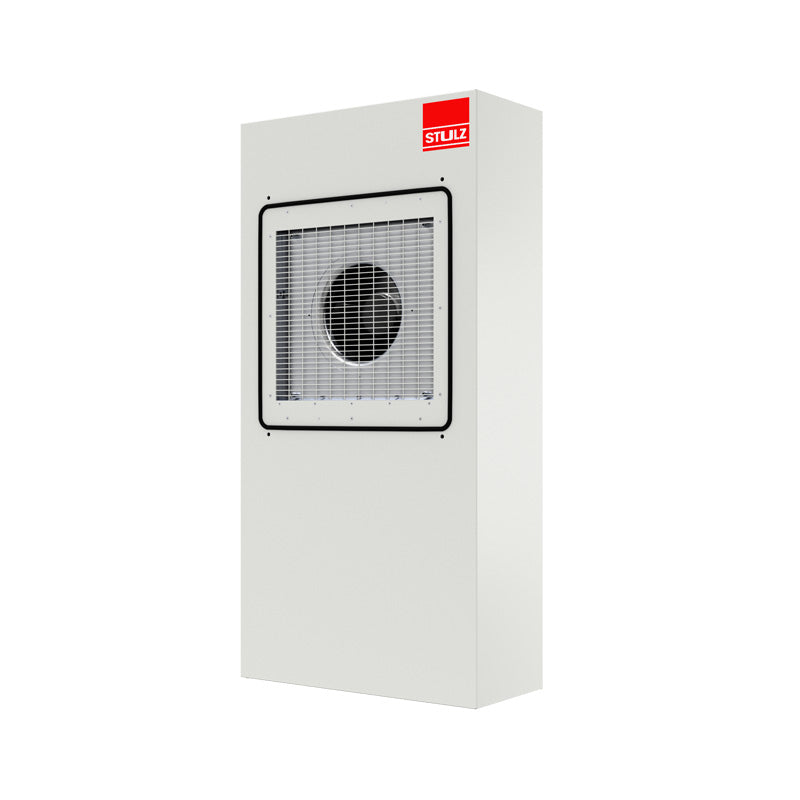
The STULZ ShelterAir FC is a Free Cooling retrofit module that bolts on to the comfort air conditioning already installed in a shelter or base station, delivering 3.5 kW to 15.0 kW of cooling at 5,400 cubic metres per hour of airflow across three sizes, for telecommunications, utility and rail sites across Australia. It is not a replacement air conditioner. The existing unit stays where it is and keeps its role as the guaranteed cooling source, while the ShelterAir FC uses filtered outside air to carry part of the annual load whenever ambient conditions allow. Indigi Power and Cooling supplies, installs, commissions and maintains ShelterAir FC retrofits nationally from hubs in Brisbane, Sydney and Melbourne.
Most of the shelter cooling market is about buying a new air conditioner. This product is not. The ShelterAir FC is described by STULZ as a retrofit container cooling unit for indoor or outdoor installation, and the reason it exists is stated plainly on the product page: to considerably cut the running costs of base stations, they can be retrofitted with the STULZ ShelterAir FC Free Cooling unit. The incumbent comfort air conditioner is not removed, not rewired out of service, and not written off. It stays installed and remains the fallback whenever outside air cannot do the job.
That distinction matters commercially far more than it looks on paper. An Australian carrier, electricity distributor, water authority or rail operator does not own one shelter. It owns hundreds, sometimes thousands, each with a working air conditioner that was capitalised years ago and still has service life left in it. Replacing that fleet is a capital program measured in years and millions. Bolting a Free Cooling module onto each shelter is a per site job that can be scheduled around normal maintenance rounds, and the energy saving lands against the asset base that already exists rather than waiting on a replacement cycle.
Indigi Power and Cooling is an Indigenous and Veteran owned critical power and cooling specialist, registered with Supply Nation and ICN Gateway. We supply, install, commission and maintain STULZ shelter cooling equipment across Australia, and we are equally comfortable working on the incumbent comfort unit that the ShelterAir FC is being fitted alongside, whatever badge is on it.
See the STULZ shelter cooling range
STULZ Shelter Cooling (english), 2 minutes 47 seconds. The video covers the full STULZ shelter and container cooling range, so it shows complete air conditioners as well as the ShelterAir FC Free Cooling module described on this page.
Why operators retrofit rather than replace
Fits what is already installed
STULZ lists simple integration into existing comfort air conditioning units as a key feature. No equipment replacement, no stranded asset, no re-approval of a new cooling design for the whole fleet.
3.5 to 15.0 kW, 5,400 m³/h
Three sizes and five model variants covering 3.5 kW, 6.0 kW and 15.0 kW at an inside temperature of 30 degrees Celsius and an outside temperature of 20 degrees Celsius.
You set the changeover point
The outside temperature value at which Free Cooling starts can be defined as you wish. That single setting is what lets one product suit both a Tasmanian hut and a Queensland roadside cabinet.
Backup operation on mains failure
STULZ lists backup operation, covering both Free Cooling and backup cooling, on failure of the main power supply. On a battery backed base station that keeps air moving when the compressor cannot run.
Indoor or outdoor mounting
FCL variants are built for outdoor installation on the shelter skin. FCL-IN variants are built for indoor installation. The same Free Cooling function, two different site constraints.
Monitoring and remote access
Connectivity with monitoring and remote access via a web interface, which is how you prove the Free Cooling hours are actually being captured across a distributed fleet.
ShelterAir FC specification at a glance
| Parameter | Specification |
|---|---|
| Product type | Free Cooling module retrofitted to existing shelter or container air conditioning. Not a standalone air conditioner. |
| Cooling capacity | 3.5 kW to 15.0 kW |
| Airflow volume | 5,400 cubic metres per hour |
| Sizes | 3 sizes, 5 model variants |
| Installation | FCL for outdoor installation, FCL-IN for indoor installation |
| Rating conditions | Inside temperature 30 degrees Celsius, outside temperature 20 degrees Celsius |
| Integration | Simple integration into existing comfort air conditioning units |
| Free Cooling changeover | Outside temperature value at which Free Cooling starts is user definable |
| Backup operation | Free Cooling and backup cooling on failure of the main power supply |
| Connectivity | Monitoring and remote access via a web interface |
| Typical applications | Base stations, air conditioning of telecommunication systems, Free Cooling for significant energy savings |
Model range and part numbers
There are five ShelterAir FC variants. Two capacities are offered in both an outdoor and an indoor version, and the largest capacity is offered as an indoor unit only. Read the model table rather than assuming a matching outdoor part exists for every indoor one.
| Model | Installation | Cooling capacity kW | Size | Dimensions W x H x D mm |
|---|---|---|---|---|
| FCL 35 | Outdoor | 3.5 | Size 2 | 720 x 612 x 604 |
| FCL-IN 35 | Indoor | 3.5 | Size 1 | 640 x 1,271 x 289 |
| FCL 60 | Outdoor | 6.0 | Size 2 | 720 x 612 x 604 |
| FCL-IN 60 | Indoor | 6.0 | Size 1 | 640 x 1,271 x 289 |
| FCL-IN 70 | Indoor | 15.0 | Size 3 | 600 x 1,250 x 600 |
Reading the model code
The naming is mostly logical, with one trap in it. The letters tell you where the unit mounts. The number is a capacity code, and while 35 and 60 map neatly to 3.5 kW and 6.0 kW, the 70 code does not follow the same pattern. Take the capacity from the model table, not from the number in the part code.
| Code | Meaning |
|---|---|
| FCL | Free Cooling unit for outdoor installation, mounted on the outside of the shelter |
| FCL-IN | Free Cooling unit for indoor installation, mounted inside the shelter |
| 35 | 3.5 kW cooling capacity |
| 60 | 6.0 kW cooling capacity |
| 70 | 15.0 kW cooling capacity. This code does not follow the pattern set by 35 and 60, so read it from the model table. |
Three sizes and what they mean for the shelter skin
Size is the practical constraint on a retrofit, because the module has to go somewhere on a shelter that was never designed with a spare aperture in it. Size 1 is tall, wide and only 289 mm deep, which suits mounting flat against an internal wall. Size 2 is a low, deep box. Size 3 is the largest and carries the 15.0 kW indoor unit.
Size 1
640 x 1,271 x 289 mm. Carries FCL-IN 35 and FCL-IN 60. The shallow 289 mm depth is what makes an indoor retrofit viable in a shelter with a full equipment rack already occupying the floor.
Size 2
720 x 612 x 604 mm. Carries FCL 35 and FCL 60, the two outdoor units. Lower and deeper than size 1, which suits mounting on the outside of the shelter where depth is not a constraint.
Size 3
600 x 1,250 x 600 mm. Carries the FCL-IN 70 at 15.0 kW, the largest unit in the range. The obvious fit for a larger walk in shelter or a container based edge compute site.
How a Free Cooling retrofit actually works
The physics is simple and that is the point. Air conditioning a shelter with a compressor means paying to move heat uphill against the outside temperature. Free Cooling means using outside air directly, when the outside air is cold enough to be useful, and paying only for fan power to move it. A Free Cooling module is therefore a fan, a filter, a damper arrangement and a controller. There is no compressor in it and it is not trying to replace one.
The ShelterAir FC sits alongside the incumbent air conditioner and shares the same room. The controller watches the outside temperature and the inside temperature. When the outside air is below the changeover point you have configured, the module opens, the fan moves 5,400 cubic metres per hour of filtered outside air through the shelter, and the compressor on the incumbent unit does not need to start. When the outside air rises above the changeover point, the module closes and the incumbent unit resumes exactly the duty it performed before the retrofit. Nothing about the fallback position changes, which is why the retrofit does not alter the site risk profile.
The changeover point is the single most important setting
STULZ lists as a key feature that the outside temperature value at which Free Cooling starts can be defined as you wish. That flexibility is not a marketing line, it is the whole engineering argument for deploying one product across a national fleet. A shelter in Ballarat and a shelter in Rockhampton have completely different ambient profiles, and a fixed factory changeover temperature would be either too conservative in the south or useless in the north.
The setting is a trade between two things. Set it high, closer to the temperature you are willing to let the shelter reach, and you capture more Free Cooling hours per year but run the shelter warmer for more of the time. Set it low and the shelter stays cooler but the module contributes fewer hours. The right answer depends on what the equipment inside will tolerate. Telecommunications hardware in a base station is generally specified for a wider envelope than IT equipment in a data hall, where ASHRAE TC 9.9 recommends 18 to 27 degrees Celsius at the inlet. Where a shelter contains both, the tighter of the two envelopes governs, and the changeover point should be set accordingly.
Backup operation when the mains supply fails
STULZ lists backup operation, covering Free Cooling and backup cooling, on failure of the main power supply. This is a genuinely useful property in the Australian remote site context. A telecommunications shelter usually holds a battery string or a DC power system sized to keep the radio equipment alive through an outage, but not sized to keep a compressor running. Cooling is often the first thing to drop off, and the shelter then heats up on the back of the load it is still carrying. A Free Cooling module draws only fan power, which is a far smaller demand, so it can keep moving air when full mechanical cooling cannot be sustained. In a summer storm outage in regional Queensland or New South Wales, that difference decides whether the site rides through or thermally trips.
Monitoring and remote access matter more on a fleet
On a single site, you can walk in and read the controller. On four hundred sites, you cannot. The ShelterAir FC offers connectivity with monitoring and remote access via a web interface, and on a retrofit program that is the mechanism that turns a claimed saving into a demonstrated one. If a damper sticks, a filter blocks or a changeover setpoint gets left at the factory default after a site visit, the module quietly stops contributing and the incumbent air conditioner picks up the whole load again. Nothing fails, nothing alarms at the network operations centre, and the energy saving simply evaporates. Remote visibility is how you catch that.
The commercial case for retrofitting an existing shelter fleet
This is the part that decides whether a Free Cooling retrofit gets funded, so it is worth setting out honestly rather than optimistically.
The capital argument
Take a typical Australian carrier, distribution network service provider, water authority or rail operator. It has a large installed base of shelters, huts and roadside cabinets. Each one already has a working comfort air conditioner in it, often a wall mounted split or a purpose built shelter unit, and that asset was capitalised at some point in the past and still has years of service life left. Replacing all of them is capital intensive, slow to schedule and disruptive to sites that carry live services. It is also hard to justify to a board when the existing units are not actually failing.
A Free Cooling retrofit changes the shape of the proposal. Instead of a replacement program, it is an efficiency program. Outside air carries part of the annual cooling load without touching the incumbent unit, so the saving lands against the asset base the organisation already owns. The existing air conditioner keeps running, keeps its remaining book value, and keeps being the guaranteed cooling source on the hot days when outside air is no use. The work per site is a mounting job, an aperture, a power connection and a controller integration rather than a plant replacement, so it can be batched into existing maintenance rounds and rolled out region by region.
There is a second order benefit that is easy to overlook. Every hour the compressor on the incumbent unit does not run is an hour of wear it does not accumulate. Compressor starts and run hours are the dominant driver of shelter air conditioner failure, so shifting hours to a fan based mode tends to extend the incumbent unit's remaining life, which pushes the replacement decision further out again.
Where the retrofit pays back fastest in Australia
Free Cooling is worth exactly as many hours per year as the local climate gives it, so the business case is climate dependent and there is no national answer. The sites that repay a retrofit fastest are inland and southern, with cool nights and a large diurnal swing. Regional Victoria, the Southern Tablelands and the Central West of New South Wales, Tasmania, the Adelaide Hills and inland South Australia all give long stretches of the year where night time and shoulder season outside air sits well below any sensible changeover point. Because base stations and equipment huts run a flat load around the clock, overnight Free Cooling hours are just as valuable as daytime ones, which favours the big diurnal swing sites strongly.
High altitude and elevated inland sites also do well. A shelter on a ridge line in the Great Dividing Range sees materially cooler ambient conditions than a coastal site at the same latitude, and those sites are common in both carrier and emergency services networks.
Where it pays back slowest, and where we will say so
Humid tropical sites are the weak case and it is better to hear that before the purchase order than after. In Darwin, Cairns, Townsville and across the Top End, outside air is rarely cool enough or dry enough to be usable for a meaningful number of hours, and overnight temperatures stay high through the wet season. A Free Cooling module fitted there may run for so few hours a year that it never repays the install cost. The same caution applies, less severely, to humid coastal sites elsewhere, and coastal salt laden air is a separate consideration for filter loading and corrosion.
The STULZ source material does not publish a payback period or a savings percentage for the ShelterAir FC, and we will not invent one. Anyone quoting you a fleet wide percentage without having looked at your ambient data, your shelter thermal envelope, your internal load and your temperature tolerance is guessing. The correct next step is a site assessment on a representative sample of shelters across your climate zones, which is what tells you which parts of the fleet are worth retrofitting and which parts are not. Talk to us about a site assessment and installation scope and we will size the exercise against your actual network.
Australian applications
- Mobile network base station shelters, which is the application STULZ names first and where the running cost argument is strongest because the load is flat and continuous
- Telecommunications huts and exchange annexes carrying transmission equipment, where reliable air conditioning of telecommunication systems is the stated purpose of the range
- Rail trackside equipment shelters housing signalling and communications hardware along regional corridors
- Water and power utility RTU and SCADA huts at pump stations, substations and reservoirs, often with no permanent staff on site
- Remote monitoring stations for environmental, seismic and meteorological networks where grid power is limited or solar and battery backed
- Existing container based edge compute sites where the cooling was specified for the original IT load and running costs have since become the issue, and which often pair with server room cooling work elsewhere on the same network
- Sites where a combined UPS and cooling package is being reviewed together, since a Free Cooling module reduces the mechanical load the standby supply has to carry
Retrofit, replace, or do nothing
The honest comparison for an operator with an existing shelter fleet is not ShelterAir FC against a competitor. It is ShelterAir FC against leaving things alone, and against a full replacement with a complete shelter air conditioner such as the STULZ TelAir or WallAir.
| Criterion | Do nothing | Retrofit ShelterAir FC | Full replacement with TelAir or WallAir |
|---|---|---|---|
| Capital cost per site | Nil up front, but the running cost continues indefinitely and the replacement bill still arrives later. | Lowest of the two capital options. One module, a mounting aperture, a power connection and controller integration. | Highest. A complete air conditioner per shelter, plus removal and disposal of the incumbent unit. |
| Site disruption | None. | Low. The incumbent unit stays in service throughout, so there is no window where the shelter is without cooling. | Highest. The shelter is without its primary cooling during the changeover, which usually means temporary cooling or a night works window. |
| Energy saving | None. The compressor carries every hour of the year. | Free Cooling hours are removed from the compressor. Strongly climate dependent, best in cool inland and southern sites, weakest in the humid tropics. | Free Cooling hours plus a modern efficient compressor and EC fans, so the ceiling is higher, but only realised once the capital is spent. |
| Filtration and monitoring | Whatever the incumbent unit has, which on an older comfort split is usually minimal and rarely networked. | Adds filtered outside air handling and web interface monitoring with remote access to a site that may currently have neither. | Full unit level filtration and controls, with the whole cooling function under one modern controller. |
| Expected asset life | Shortest. Compressor run hours keep accumulating at the current rate. | Extends the incumbent unit's remaining life by shifting hours off the compressor, and adds a new asset with its own service life. | Longest. A new unit resets the clock entirely. See the TelAir page and the WallAir page. |
These three options are not mutually exclusive across a fleet. The usual outcome of a proper assessment is a split: retrofit the shelters in the cool climate zones where Free Cooling hours are plentiful and the incumbent unit is sound, replace the shelters where the air conditioner is already near end of life or undersized, and leave the humid tropical sites alone until their units come up for renewal.
Installation, commissioning and maintenance in Australia
A ShelterAir FC retrofit is a lighter job than a full air conditioner replacement, but it is still licensed work. Electrical connection and any change to the shelter distribution board must be carried out by a licensed electrician to AS/NZS 3000. Where the retrofit involves working on the refrigerant circuit of the incumbent air conditioner, for example relocating it, isolating it or reconnecting it around the new aperture, that work requires an ARCtick licensed refrigeration technician under the Ozone Protection and Synthetic Greenhouse Gas Management Regulations. Because the module introduces outside air into an occupiable space through a mechanical ventilation path, AS/NZS 3666 hygiene obligations apply to the filter and air handling arrangement. Indigi holds these capabilities in house rather than subcontracting the critical path.
Typical retrofit scope covers a site survey and thermal assessment of the shelter, confirmation that the incumbent unit is sound enough to be worth retaining, selection between an FCL outdoor and an FCL-IN indoor unit against the available wall area and internal clearance, cutting and weatherproofing the aperture, mounting and sealing, electrical connection, controller integration with the existing comfort unit so the two do not fight each other, setting the Free Cooling changeover point for the site's climate zone, connecting the web interface for remote monitoring, and a documented commissioning record per site. On a fleet rollout we also recommend a pilot batch across two or three climate zones before the full program is committed.
Pricing depends entirely on scope and site count, and a single shelter retrofit sits well below a full room installation. For context, our indicative pricing for server room cooling design and installation runs from $8,000 to $15,000 for small rooms, $25,000 to $45,000 for medium installations and $45,000 to $60,000 plus for large projects. A shelter Free Cooling retrofit is a smaller and more repeatable piece of work than any of those, and unit rates fall further across a fleet program. Ask us for a per site rate against your actual shelter drawings.
Ongoing maintenance is straightforward but must not be skipped. Filters are the single biggest determinant of whether the module keeps delivering, because a blocked filter quietly reduces Free Cooling airflow until the incumbent compressor is carrying the load again. Dampers and actuators need checking, sensors need verifying against a reference so the changeover point is acting on a true reading, and the alarm and event history should be reviewed remotely between site visits. See our CRAC unit maintenance services and DX CRAC servicing pages for how we structure this, and note that we can service the incumbent comfort unit on the same visit.
Frequently asked questions
What is the STULZ ShelterAir FC?
The ShelterAir FC is a Free Cooling retrofit module for shelters and containers, not a complete air conditioner. STULZ describes it as a retrofit container cooling unit for indoor or outdoor installation, fitted to base stations so that outside air carries part of the cooling load and the running cost of the site falls. It delivers 3.5 kW to 15.0 kW at 5,400 cubic metres per hour across three sizes and five model variants.
Can the ShelterAir FC be fitted to an air conditioner that is already installed?
Yes. That is the entire purpose of the product. STULZ lists simple integration into existing comfort air conditioning units as a key feature, and lists the Free Cooling system as one that can be retrofitted into existing systems. The incumbent unit is not removed and continues to provide guaranteed cooling whenever outside air is too warm to be usable.
What is the difference between FCL and FCL-IN?
FCL is the version for outdoor installation, mounted on the outside of the shelter, and is available as FCL 35 at 3.5 kW and FCL 60 at 6.0 kW, both in size 2 at 720 x 612 x 604 mm. FCL-IN is the version for indoor installation and is available as FCL-IN 35 and FCL-IN 60 in size 1 at 640 x 1,271 x 289 mm, plus FCL-IN 70 at 15.0 kW in size 3 at 600 x 1,250 x 600 mm. The 15.0 kW capacity is offered as an indoor unit only.
At what outside temperature does Free Cooling start?
It is a setting, not a fixed value. STULZ states that the outside temperature value at which Free Cooling starts can be defined as you wish, which lets the changeover point be tuned to the local climate and to how warm the site is willing to let the shelter run. A Tasmanian hut and a central Queensland cabinet would normally be commissioned with different setpoints.
How much energy will a Free Cooling retrofit save on an Australian base station?
STULZ does not publish a payback period or a savings percentage for the ShelterAir FC, so we will not quote one. The saving is proportional to the number of hours per year that outside air is below your changeover point, which makes it strongly climate dependent. Cool inland and southern sites with large diurnal swings, such as regional Victoria, the Southern Tablelands, the Central West, Tasmania and inland South Australia, do best. Humid tropical sites such as Darwin and Cairns do worst, because outside air is rarely usable. The only reliable figure comes from a site assessment against your ambient data and load.
What happens to cooling if the mains supply fails?
STULZ lists backup operation, covering Free Cooling and backup cooling, on failure of the main power supply. Because a Free Cooling module needs only fan power rather than compressor power, it can keep moving air on a battery or standby supply that would not sustain full mechanical cooling. On remote Australian sites subject to storm outages, that can be the difference between riding through an event and thermally tripping.
Who installs and services STULZ shelter cooling equipment in Australia?
Indigi Power and Cooling supplies, installs, commissions and maintains STULZ shelter cooling equipment across Australia from hubs in Brisbane, Sydney and Melbourne. Electrical work is carried out to AS/NZS 3000, refrigerant work by ARCtick licensed technicians, and mechanical ventilation hygiene obligations under AS/NZS 3666 are addressed as part of the scope. We also service the incumbent comfort air conditioner on the same visit, whatever brand it is.
Where we install and service
Brisbane and QLD
Brisbane CBD, Woolloongabba, Eight Mile Plains, Port of Brisbane, Gold Coast, Sunshine Coast, Ipswich, Townsville, Cairns
National HQ at Tingalpa. A split fleet story: the Darling Downs and Granite Belt retrofit well, the tropical coast usually does not.
Sydney and NSW
Sydney CBD, Parramatta, North Ryde, Macquarie Park, Western Sydney, Newcastle, Wollongong, Canberra (ACT)
The Southern Tablelands, Central West and Canberra region carry the strongest retrofit case in the state, on both carrier and rail shelters.
Melbourne and VIC
Melbourne CBD, Port Melbourne, Docklands, Dandenong, Tullamarine, Geelong, Ballarat, regional Victoria
The best mainland retrofit economics we see. Regional Victorian shelters give long overnight and shoulder season Free Cooling hours.
Perth and WA
Perth CBD, Fremantle, Kalgoorlie, Pilbara, regional WA
Goldfields and inland sites have big diurnal swings that suit Free Cooling. Pilbara sites need a realistic assessment before committing.
Adelaide and SA
Adelaide CBD, Port Adelaide, Salisbury, Mount Gambier, Whyalla, regional SA
Inland South Australia and the South East give plentiful Free Cooling hours. Served from the Melbourne hub on fleet programs.
Darwin and NT
Darwin CBD, Palmerston, Katherine, Alice Springs, remote NT sites
Darwin is the weakest retrofit case in the country. Alice Springs and the arid centre are a different proposition and worth assessing.
Western Australia, Tasmania and Pacific Islands: Tasmania has the best Free Cooling climate in the country for a shelter retrofit, and we schedule Tasmanian, Western Australian and Pacific Island work in planned blocks so travel is shared across multiple sites in one mobilisation. Contact us to discuss scheduling.
Related products and services
- STULZ TelAir telecom shelter and equipment room cooling, the full replacement option
- STULZ WallAir outdoor container cooling, for wall mounted complete units
- CRAC installation and commissioning
- CRAC unit maintenance services Australia
- DX CRAC servicing across Brisbane, Sydney and Melbourne
- Server room cooling Australia
- Server room heat load calculator
- Server room UPS and cooling packages
|
Find out which of your shelters are worth retrofitting Send us your shelter locations, the make and age of the incumbent air conditioners and the internal load, and we will tell you which climate zones justify a ShelterAir FC retrofit and which do not. Indigi Power and Cooling is Indigenous and Veteran owned, and registered with Supply Nation and ICN Gateway. Contact Indigi Power and Cooling |
Partner with Us
Reliable Power & Cooling Solutions from Indigi Power & Cooling Expert supply, installation, and contracting services for critical infrastructure across Australia.